QR Code Contact Tracing: A Complete Guide

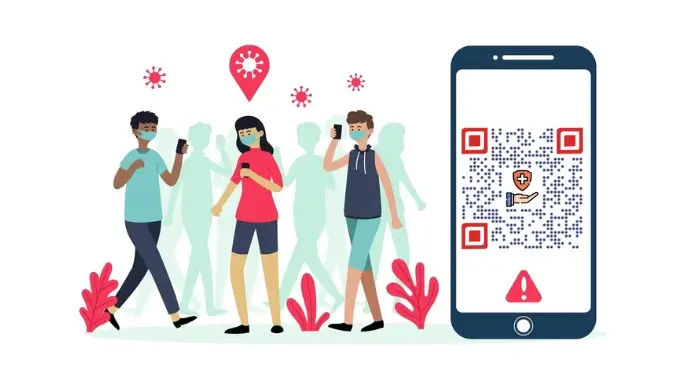
For better or for worse, we all know what went down during the global pandemic of 2020. Vaccinations, lockdowns, and restrictions became the talk of the town.
Another term that you might have come across is “contact tracing”.
For the uninitiated, contact tracing means finding out people who have been exposed to an infectious disease.
Public health professionals could reach out to the ones who’ve come in contact with an infected individual.
Subsequently, they give instructions and support to the exposed individuals. For decades, public health agencies have utilized contact tracing to stop the spread of contagious diseases.
And one of the best (and contactless) modes of contact tracing that emerged during the pandemic is via QR Code.
So how is it possible? It is, via QR Code contact tracing. Read further to know more!
A. What is a QR Code contact tracing app
A contact tracing app tracks whom each user has been in proximity to. It then notifies all affected users when one of them tests positive for infection.
The app also alerts users when an infected individual is nearby to avert potential infection. They can also monitor if an infected user is adhering to social-distancing rules.
A QR Code contact tracing app employs all these features, powered by a QR Code.
B. Places where a QR Code contact tracing app can be used
QR Code contact tracing is effective in breaking the chain of transmission for infectious outbreaks.
Here are some places where you can employ QR Code contact tracing.
1. At the workplace

Many physically demanding jobs and the ones that need use of equipment can’t be done remotely.
Some of these include:
– Caregiving
– Running machines (in factories)
– Using lab equipment
To ensure employee safety, many workplaces use QR Code contact tracing.
Before employees enter the premises to clock in, they quickly scan the QR Code and mark themselves safe. If someone has symptoms or has come in contact earlier, they can then take precautionary measures.
2. At educational institutions

Though the world moved to online classes and e-learning, many still prefer learning in offline classes.
Hence, many educational institutions have started resuming the usual offline-classes. And to ensure safety for all, they use QR Code contact tracing.
It helps ensure that students and the staff are safe from the infectious diseases to focus on learning.
3. At hospitals
Hospitals are one of the most sensitive places for infection spread.
Not only you need to protect the visitors and the attendants but the vulnerable patients too. An app for QR Code contact tracing goes a long way to secure lives.
4. At amusement parks

Amusement parks are fun, right? But it’s no fun when infected people would pose a danger to normal people.
Using QR Code contact tracing along with an efficient ticketing system could be the gamechanger.
C. How to create QR Code for contact tracing
There are two ways in which you can create QR Code contact tracing.
If you have an information system of your own, you can simply integrate QR Code generation into it. This is done with the help of QR Code API.
It helps you create QR Codes in real-time automatically. Hence, no need for manual intervention every time you need a QR Code.
To follow the steps, skip to section 1.
But if you don’t have an information system of your own, there’s another way. You can create a digital form for people to fill out. And then create a QR Code with this form’s link. This helps out greatly in QR Code contact tracing.
Related : QR Code For Link
1. Integrate QR Code contact tracing via API:
a. Choose your preferred browser and go to QR Code API. Signup for the free trial
On successful sign up, you will receive 50 API requests for free
b. After the page that loads, you may view your:
– Cycle usage
– Info on the number of days left
– Total allowable requests, and
– Requests made
You can also choose Obtain API Key from the menu. Now click on Create
When you opt to sign-up via Google, click on Create. A 6-digit code will be sent to your email address
Copy the code and then paste it into the dialogue box. Your API Key will then be visible to you
c. Copy the API key, then click on Documentation on the dashboard
d. Now, scroll down to see the Authorize button on the right
e. To proceed, click on the Authorize button
You will see a pop-up that will prompt you to paste the API key in the value box. Click on Authorize after pasting it
f. Select the relevant QR Code category and then click on Test
g. Enter the information you wish to add to the QR Code. Then, begin personalizing it by choosing its size and other design elements
h. Click on Execute once you’re done finalizing the QR Code content and other parameters
i. You’ll see various options such as Curl, Response URL, and Response Body
When you slightly scroll down, you can see a QR Code with the encoded content
j. In the final step, copy the Response URL and integrate it into your information system or mobile app. This is how you will set-up your QR Code contact tracing.
2. Via Website URL QR Code
First, go to any digital forms service such as Google Forms, Survey Monkey, and Zoho. Then, create the form with fields that you’d like people to fill out.
Once done, copy the sharable link to it and follow these steps:
a. Head on to Scanova’s Website URL category
c. Add the form link you copied earlier.. After that, click Continue
d. Name your QR Code on the next page. Here, the Dynamic selection is made by default. Enter a name for the QR Code on this page to continue
e. Next, you’ll see a QR Code image on the right with the Edit Design option under it. It’ll help you customize the QR Code design by either adding a logo and color or adding a background image
f. If you choose to design the QR Code, click on Update Changes on finalizing the design. Next, click on Download
f. You will see a pop-up box for a quick sign-up. Don’t worry, you’ll not have to give away your credit card details
g. Once done signing up, click On Download again. Enter the size and format of the QR Code image in the following pop-up
h. After this, select Export
Your QR Code will be downloaded and ready for use
Read more about the Website URL QR Code here!
D. Best practices for creating QR Code contact tracing app
By now you know how to integrate and use QR Code to a contact tracing app. So it’s time for you to learn a couple of best practices before getting started!
1. Test your QR Code

When it comes to using QR Code for contact tracing, you‘d want it to work seamlessly, right?
To achieve that, always test your QR Code before using or sharing them.
For best results, test them using multiple devices and operating systems (iOS and Android).
2. Focus on QR Code’s proper size

For a QR Code to function properly, it should be of the right size. If the QR Code is too small or large, it will face scanning issues.
Want to know more? Read our helpful guide to calculate the ideal QR Code size for your use case.
3. Use custom logos and colors

While a standard black and white QR Code serves the purpose, it looks far from attractive.
A customized QR Code with your brand colors and logo looks way better. It also leads to high scan rates.
Don’t know where to get started? Read more about it here!
4. Ensure QR Code’s optimal readability

For your end users to achieve error-free scans, make sure your QR Code is not pixelated.
To ensure that, export a high-quality image of the QR Code in formats such as EPS, SVG, and PDF. Even if you resize them, they don’t pixelate.
Before experimenting with colors, you should:
- Choose a light color with a dark background (and vice-versa)
- Ensure enough contrast between the background and the foreground
Summing Up
The usage of contact tracing has definitely soared amidst the global pandemic of 2020. And QR Code technology makes contact tracing safer.
If you’re still reading, you’ve already learned everything about QR Code Contact Tracing. If you have any questions, let us know in the comments.