GS1 2D Barcode: The Next Generation of Barcodes
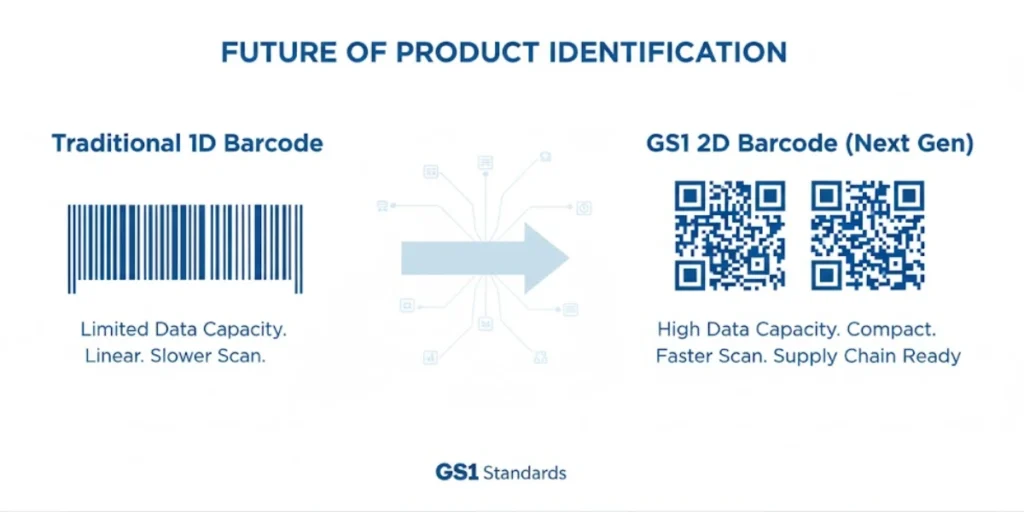
In a nutshell: GS1 2D barcodes are the next generation of barcodes, replacing traditional 1D stripes with smart, square codes. They store more product data, including GTINs, expiry dates, and batch numbers, and can link to live online information.
The familiar black-and-white stripes on product packages are one-dimensional (1D) barcodes. They store a small amount of information, such as a product ID number. Now, GS1 2D barcodes are here, and they can carry much more data in a tiny square code.
Consumers expect transparency. Regulators demand traceability. Retailers need faster checkouts, fewer errors, and better recall handling. Supply chains must respond in real-time to expiration risks and counterfeit threats.
This is why GS1 introduced GS1 2D barcodes.
A single GS1 2D barcode can include a product’s GTIN plus expiry dates, batch numbers, serial numbers, and even a web link to live product information. In simple terms, it gives every product a mini webpage that anyone can scan.
GS1 has already announced that by 2027, retailers worldwide should be ready to scan 2D barcodes at checkout. This initiative, known as Sunrise 2027, will make 2D barcodes the new standard on store shelves.
A. What is a GS1 2D barcode and how does it work?
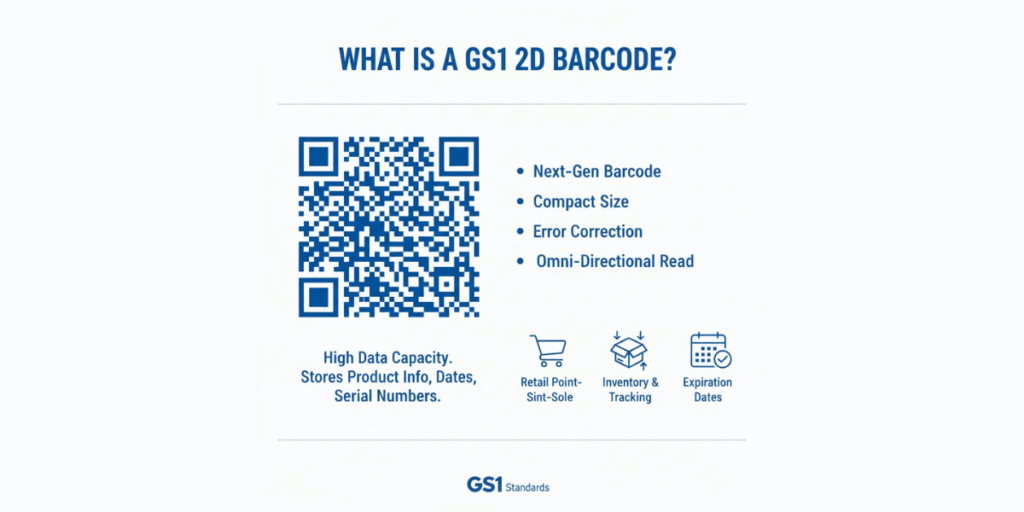
A GS1 2D barcode is a two-dimensional barcode that looks like a square made of many tiny dots or squares.
Unlike the old 1D barcodes (UPC/EAN) that encode about 12 digits, 2D barcodes can encode thousands of characters of information.
For example, a QR Code (a type of 2D barcode) can hold up to 4,296 alphanumeric characters, and a GS1 DataMatrix code can hold up to 2,335 characters. This means one small code can contain a lot more details than the traditional stripe barcode.
GS1 2D barcodes come in a few forms. The two most common are GS1 QR Codes and GS1 DataMatrix codes.
Both are standardized by GS1, and both can store the product’s GTIN. Additionally, they include extra data, such as dates, batch numbers, or web links.
A GS1 DataMatrix is commonly used in healthcare. Likewise, GS1 QR Codes are widely utilized for retail packaging and consumer scanning.
Data capacity comparison
- 1D UPC barcode: ~12 digits
- QR Code: up to 4,296 alphanumeric characters
- GS1 DataMatrix: up to 2,335 characters
This means a single code can store structured product data plus web links.
B. What is the difference between 1D barcodes and 2D barcodes?
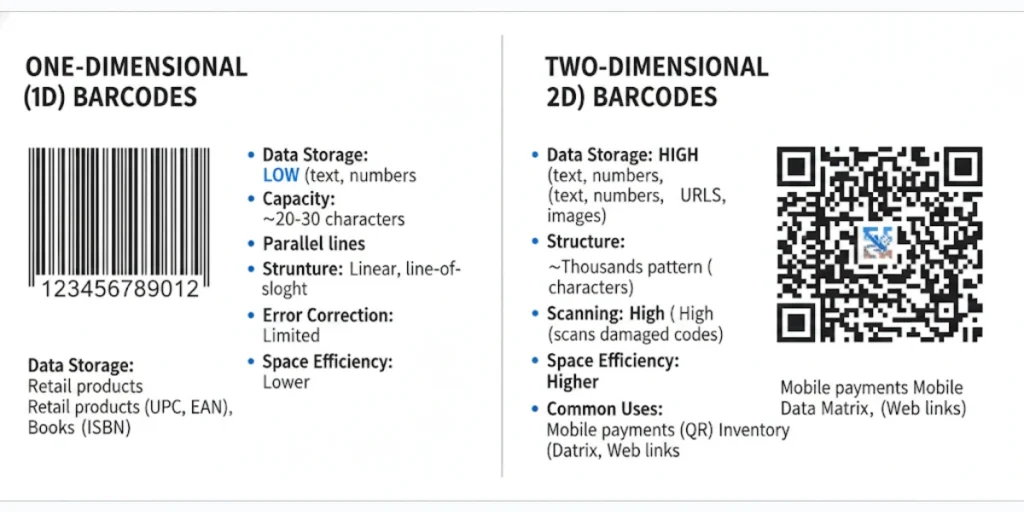
The primary difference between a 1D barcode and a 2D barcode lies in their data capacity and capability. A 1D barcode is essentially an identifier – it usually needs a database lookup to get product info.
In contrast, a GS1 2D barcode carries the information within the code itself. It can pack in rich details directly.
Scanning a 2D code can reveal details such as the product name, expiration date, lot number, or even a URL to a webpage with additional information.
A PwC study found that 73% of consumers are willing to pay more for products with full transparency. Source: PwC Consumer Intelligence Series
Another big difference is ease of scanning. 2D barcodes can be scanned from any direction (no need to align a laser) and can still be read if partly damaged, thanks to built-in error correction.
Importantly, GS1 has designed 2D barcodes to be backward-compatible with current systems. This means retail checkout scanners can still read the product ID (GTIN) from the 2D code, just like they do from a UPC.
In other words, one GS1 2D code can replace the old barcode at checkout and provide additional information when scanned with a smartphone.
“Try generating a GS1 2D barcode for retail checkout”
How scanning works
When scanned, a GS1 2D barcode:
- Decodes structured data (GTIN, dates, lot numbers)
- Interprets GS1 application identifiers
- Optionally opens a web page using GS1 Digital Link
C. What are the benefits of using GS1 2D barcodes?
GS1 2D barcodes aren’t just about squeezing more data into a code – they open up new possibilities. Key benefits include:
1. Better product tracking and safety
A 2D barcode can include detailed product data (like batch numbers or origins) that strengthen safety checks and build trust. For example, in a recall, you can scan and instantly know if a specific item is affected.
GS1 estimates that faster, more precise recalls enabled by advanced barcodes can reduce recall costs by up to 30%. Source: gs1traceability
2. Dynamic updates
Brands can update the information associated with a 2D barcode in real-time (dynamically) without altering the printed code. This means the code can always point to up-to-date details (such as a new webpage if information changes).
3. Less packaging clutter
One GS1 2D barcode can replace multiple labels and codes on a single packaging item. Instead of having separate barcodes for price, lot, and a QR for marketing, a single code can serve all purposes. This keeps the package design cleaner.
The European Commission has confirmed that digital product passports will become mandatory for several product categories this decade. Source: European Commission Circular Economy Action Plan
4. Global standards
GS1 2D barcodes work worldwide and help meet regulations in different regions. For instance, the EU’s upcoming digital product passport rules can be met using GS1 2D codes.
5. Efficient operations
These codes improve inventory management and speed up processes like recalls. A quick scan can reveal a product’s expiry date or authenticity, making supply chain operations more efficient.
All these advantages are possible because a GS1 2D barcode can act as a gateway to online data. Using the GS1 Digital Link standard, the code essentially becomes a web link that leads to real-time product information.
In short, it makes barcodes as smart as websites, bridging the physical product to digital content.
Real-world use cases show these benefits clearly. For example, if a product has an expiration date encoded, a supermarket scanner can alert the cashier if the item has expired before selling it.
Consumers scanning a GS1 2D code at home can instantly check if their product is part of a recall or determine its origin. The result is clear information and confidence at every step.
Even a 1% improvement in inventory accuracy can translate into millions in recovered revenue for large retailers. Source: GS1 & retail industry benchmarks
D. How are GS1 2D barcodes used in real-world scenarios today?
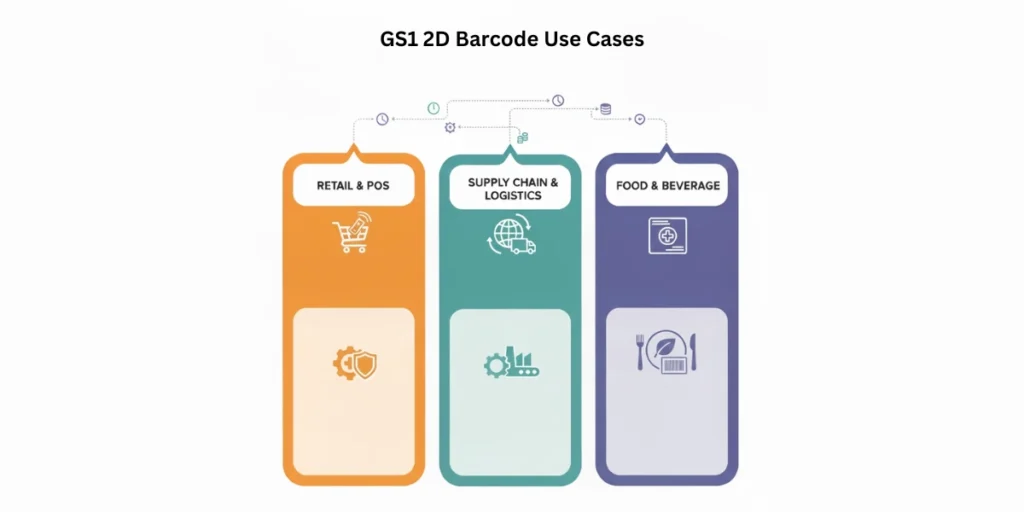
Many industries are already using GS1 2D barcodes to improve processes and customer experiences.
In healthcare, medicines and medical devices carry GS1 DataMatrix codes. This is used for tracking and to fight counterfeiting.
This allows pharmacists to scan a drug and instantly verify its authenticity. It also lets them check details such as lot number and expiration date.
In retail, brands are adding GS1 QR Codes to packages so shoppers can scan them with their phones.
A quick scan might show nutritional information, usage tips, or a promo offer. These are the details that wouldn’t fit on a normal label.
In food and beverage industry, 2D codes help consumers learn where their food comes from.
This type of smart packaging makes it easier for consumers to access the information they need.
In the U.S., large retailers are on board. GS1 US and retail leaders have announced that by 2027, all consumer products will feature a 2D code (like to a QR Code) instead of the traditional UPC.
Some retailers have even said they might stop accepting products that only have old barcodes.
For example, Dillard’s (a department store) has warned that items without 2D codes could be kept off shelves, and Walmart is expected to follow suit.
Common types of GS1 2D barcodes
- GS1 QR Code – widely used on retail packaging and consumer products
- GS1 DataMatrix – commonly used in healthcare and pharmaceuticals
Both formats follow GS1 standards and support advanced product data.
E. How to prepare your business for GS1 2D barcodes?
Moving to GS1 2D barcodes does not mean you need to rebuild everything at once. Most businesses can prepare in small, practical steps. The key is to start early and test before 2027 arrives.
Below is a simple, clear way to get ready.
1. Make sure your scanners can read 2D barcodes
The first step is checking your scanning hardware.
Many modern checkout scanners already support 2D barcodes. This is especially true for image-based scanners used in retail today. But older laser scanners may only read 1D barcodes.
What to do:
- Audit your current scanners across stores, warehouses, and packing lines
- Confirm whether they can read QR Codes and DataMatrix codes
- Plan upgrades only where needed
This step is important because GS1 2D barcodes are designed to work at checkout. If scanners cannot read them, the benefits stop there.
The good news is that most retailers are already upgrading scanners as part of normal refresh cycles.
2. Update packaging artwork thoughtfully
GS1 2D barcodes will appear on product packaging, so packaging design needs a small update.
This does not mean redesigning the whole pack.
What to consider:
- Replace or complement the existing UPC with a GS1 2D barcode
- Follow size and contrast guidelines so the code scans easily
- Place the barcode where scanners and phones can access it
GS1 allows a transition period where both 1D and 2D barcodes can appear on the same package. This makes the shift low risk.
A clean design also matters. One GS1 2D barcode can replace multiple codes, which often makes packaging simpler, not more crowded.
3. Decide what product data you want to encode
This is a strategic step, not a technical one.
A GS1 2D barcode can store more than just a product ID. You should decide which data adds real value to your business and customers.
Common data choices include:
- GTIN for product identification
- Batch or lot number for traceability
- Expiry or best-before date for safety
- Serial number for anti-counterfeiting
- A product URL using GS1 Digital Link
Start small. Many brands begin with GTIN plus a product web link. More data can be added later as systems mature.
The goal is clarity, not complexity.
4. Test across retail systems and smartphones
Before rolling out at scale, testing is critical.
A GS1 2D barcode must work in different environments:
- Retail checkout scanners
- Warehouse scanners
- Smartphone cameras used by consumers
What to test:
- Does the barcode scan quickly at checkout?
- Does it still scan if slightly damaged?
- Does the consumer link open correctly on different phones?
Testing early helps avoid surprises and builds confidence across teams.
5. Align internal teams early
GS1 2D barcodes touch many teams.
Packaging, IT, supply chain, compliance, and marketing all play a role. Preparation works best when these teams align early on goals and timelines.
Simple internal alignment avoids delays later.
6. Use GS1 guidelines and tools
GS1 provides clear documentation, standards, and examples for implementing 2D barcodes correctly.
These guidelines help businesses:
- Encode data in the right format
- Avoid scanning issues
- Stay compliant with global standards
Following these standards ensures your barcodes work everywhere, not just in one market.
F. GS1 2D barcode FAQs: Common questions answered

1. What is a GS1 2D barcode?
A GS1 2D barcode is a two-dimensional barcode that follows standards set by GS1.
Unlike traditional 1D barcodes, it can store much more data. It includes product’s GTIN, batch number, expiry date, and even a web link for consumers.
2. What types of GS1 2D barcodes are used today?
The most common GS1 2D barcodes include:
- GS1 QR Code
- GS1 DataMatrix
Both support structured data, such as GTINs, lot numbers, and expiration dates.
3. Why is GS1 moving from 1D barcodes to 2D barcodes?
1D barcodes are reaching their limits. They cannot store enough data to meet modern needs. This includes traceability, recalls, and consumer transparency.
GS1 2D barcodes solve this by carrying more information in a single scan.
4. What data can be stored in a GS1 2D barcode?
A GS1 2D barcode can store:
- Global Trade Item Number (GTIN)
- Batch or lot number
- End or best-before date
- Serial number
- Product URLs using GS1 Digital Link
All this data is encoded in a standardized, machine-readable format.
5. What is GS1 Sunrise 2027 and how does it relate to GS1 2D barcodes?
GS1 Sunrise 2027 is a global initiative that asks retailers to be ready to scan GS1 2D barcodes at checkout by 2027.
Getting Ready for the Future
GS1 has made it clear that the move to 2D barcodes is unavoidable. The future is positive, and companies that act early will stay ahead.
Many modern checkout scanners already read these codes. Also, most smartphones can scan them.
GS1 also provides clear guidelines and tools to help companies use the correct data and format. When brands plan now, the shift becomes smooth and low risk.
This shift benefits all industries. Brands and retailers unlock a stronger flow of information.
They represent the next generation of barcodes. This keeps products connected to the digital world with one simple scan.
You can get started today with Scanova QR Code Generator!
