QR Code Alternatives in 2026: 8 Options Compared and When to Use Each

In a nutshell (TL;DR): NFC taps convert at 60-80% versus 35-50% for QR scans at the point of service. So why are QR Codes still winning most marketing budgets? Because conversion is just one number in a much bigger equation. NFC tags cost 100x as much as a printed QR Code. Only about 20% of the global population owns NFC-ready devices, so reach is capped. And the GS1 Sunrise 2027 mandate is pushing every consumer brand on earth toward 2D codes on packaging by the end of next year. In this guide, I compare 8 alternatives with real cost math, named brand case studies, and the trade-off no one warns you about: scan friction.
A. Why am I writing this?
I work in content marketing at Scanova, a QR Code platform. So yes, I have a horse in this race. But after watching enterprise teams pick the wrong tool more times than I can count, I felt this guide was worth writing.
Most “QR Code alternatives” posts I read fall into one of two camps. They list every option with a one-line pro and con. Or they cherry-pick to sell a product. Neither helps the brand manager decide what goes on 10 million units of packaging. Or the security lead asked whether QR Codes pose a security risk.
So I will skip the surface stuff. I will share the real cost math, the conversion data, and the case studies that have changed minds in actual buying meetings. Some of it will go against what your vendor told you.
B. What is GS1 Sunrise 2027 and why does it matter?

Before we look at alternatives, you need to know about Sunrise 2027. It changes the math.
GS1, the global body that runs barcode standards, has set the end of 2027 as the target for retail point-of-sale systems worldwide to scan 2D codes (mostly QR Codes with GS1 Digital Link) at the till. POS systems in 48 countries are already in pilot. Walmart, Carrefour, Lidl, Tesco, and Wegmans are running 2D-at-checkout tests today.
What does that mean for you? One QR Code on your packaging will replace the UPC barcode, the recycling logo, the allergen warnings, and the marketing landing page. Procter & Gamble, Coca-Cola, PepsiCo, Nestle, and L’Oreal already have GS1 Digital Link pilots in market, per LinkScan’s industry breakdown.
For pharma, this shift is older and stricter. The EU Falsified Medicines Directive has required GS1 DataMatrix codes on prescription packaging since 2019. The US DSCSA rules push in the same direction. Pharma did this migration first under regulatory force.
The point: if you sell a physical product, the question of “QR or alternative” is partly being decided for you. Your packaging needs a 2D code by 2027. The only real question is what you do with it.
C. What are the 8 best QR code alternatives in 2026?
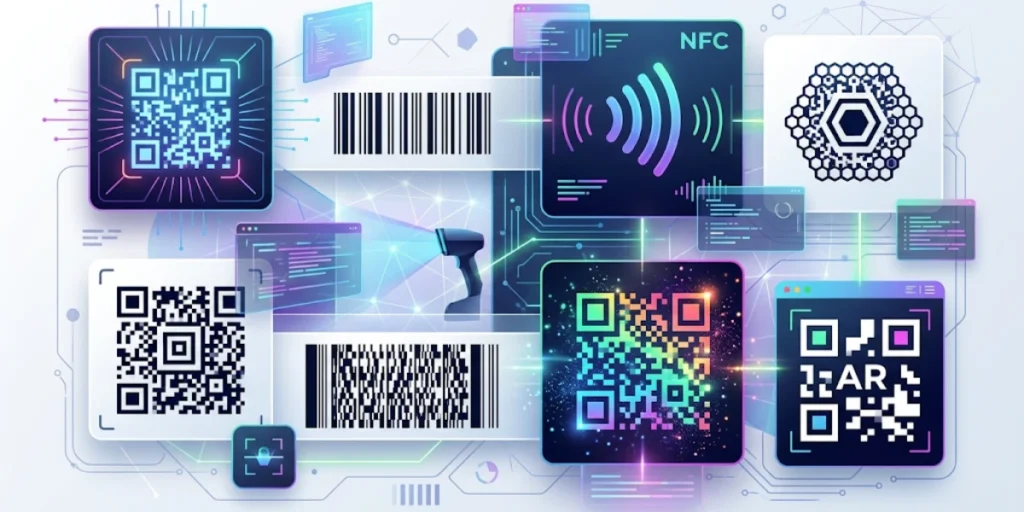
For each alternative below, I am looking at five factors: range, total cost at scale, required hardware, data capacity, and security. Real numbers, not adjectives.
1. NFC (Near Field Communication)
NFC lets two devices share data when they are within about 4 cm. It powers Apple Pay, Google Pay, and most contactless cards.
NFC has one big win: friction. The user taps. The link opens in under a second. No camera, no aim, no app. Research from TAPro shows that NFC taps convert at 60-80% of customer interactions. QR scans land at 35 to 50%. That is a real gap.
But NFC has three real limits.
First, reach. Only about 1 in 5 phones globally can read NFC reliably. iPhones below the iPhone 7 cannot read tags in the background.
Second, cost. Each tag runs 10 to 20 cents. Add production and embedding and you are looking at 50 cents to a dollar per item, all in. A QR Code costs the price of ink.
Third, visibility. NFC is invisible. The user has to know to tap. On a poster or shelf, that is a problem. NFC works best where you can train the user: a kiosk, a smart business card, or inside a luxury product where a “tap to verify” message earns its space.
The luxury world has gone all in on NFC for one reason: authentication. The Aura Blockchain Consortium, founded by LVMH, Prada, Cartier, and Richemont, has registered over 50 million luxury items with NFC chips that link to a digital product passport.
Maison Margiela embeds chips in shoe soles. Prada hides them inside leather goods. The chip blocks counterfeits in a way QR cannot, since it carries a unique signed credential.
Best fit: Tap-to-pay, NFC business cards, luxury authentication, smart kiosks.
Worst fit: Mass print campaigns, billboards, anywhere reach matters more than feel.
2. RFID (Radio Frequency Identification)
RFID uses radio waves to read tags from a distance. Some tags read from a few inches. Others reach 30 feet or more.
The big win? You can read hundreds of tags at once. No line of sight. The reader picks them all up. That is why retail and logistics teams love it.
AssetPulse’s 2026 comparison puts it well: a worker has to aim at every barcode, but an RFID system can pick up hundreds of tags per second, even through boxes.
But RFID is an internal tool, not a consumer one. Tags cost 10 cents to several dollars each. Readers run from $500 to $5,000. The infrastructure decision sits with the supply chain team, not marketing.
Prada uses RFID for in-store inventory and to flag gray-market leakage. The same product also carries an NFC chip for consumers. The two technologies do different jobs.
Best fit: Inventory, supply chain, retail loss prevention, asset tracking.
Worst fit: Consumer marketing. Most shoppers do not own RFID readers.
3. BLE Beacons (Bluetooth Low Energy)
BLE beacons can send signals up to 100 meters. Phones with the right app pick it up. The app then triggers an action, like a coupon or a map.
Retail stores use BLE for indoor marketing. Museums use it for self-guided tours. Stadiums use it for seat upgrades.
The catch is real. The user needs an app installed and Bluetooth on. Without one, the beacon does nothing. So BLE works best when you already own the user’s app real estate.
Beacons cost $5 to $30 each. Maintenance is the hidden cost. Batteries die. Beacons drift. You need a team to manage them.
Best fit: In-store offers when you have a strong owned app, museum tours, and smart venues.
Worst fit: One-time interactions. Print campaigns. Anywhere an app install is too much friction.
4. Traditional Barcodes (1D)
The classic black-and-white stripe. Barcodes have been on cereal boxes since 1974. They still work.
Barcodes hold 8 to 15 characters. They need a clean line of sight. But they are cheap to print and read fast at the till.
Here is the catch: their days are numbered. With Sunrise 2027 on track and the EU Digital Product Passport rolling out from 2027 onward, every brand on a retail shelf will print 2D codes alongside (and eventually replace) the old stripe.
Best fit: Retail checkout, basic inventory, product IDs.
Worst fit: Marketing. The barcode does not link to a webpage on its own.
5. Data Matrix Codes
Data matrix codes look like a smaller cousin of the QR Code. Both are 2D and store data in a grid of squares.
The difference? Data matrix codes pack more data into less space. So they win on tiny labels. Pharma uses them for serial numbers, batch numbers, and expiry dates.
The trade-off: most phone cameras do not pick up data matrix by default. Pharma teams scan them with dedicated readers. So, as a marketing tool, a data matrix is a non-starter.
Best fit: Pharma serial numbers, small medical devices, electronics labels.
Worst fit: Consumer-facing campaigns.
6. SnapTags
SnapTags are a 2D code shaped like a ring around a brand logo. The user takes a photo and texts it to a short code, or uses a SnapTag app.
The branding looks better than a plain QR Code. But the workflow is dead. SnapTag use has dropped sharply since QR Codes went mainstream. I include it for completeness, not because I would build a campaign around it.
Best fit: Almost nothing, in 2026.
7. Short URLs and Branded Links
A short URL is the simplest alternative. Print a clean link on your poster. The user types it in.
Tools like Bitly and Rebrandly add tracking and branded domains. So you can see clicks and tweak the link later.
The downside is real. Typing is slow. People mistype. A wrong character can send your traffic to a typo-squatter, and typos kill conversion at scale.
But short URLs win in audio. Radio ads, podcasts, voice ads. There is no scan in audio. The user hears the link and types it later.
Best fit: Audio-first channels, voice ads, anything where the user is not holding a screen.
Worst fit: Print where space is tight.
8. Image Recognition and AR
Some apps use the phone camera to scan a logo, an object, or a scene. The app then triggers content. Snapchat, Google Lens, and IKEA Place all do this.
AR goes further. The user sees digital content overlaid on the real world. Think Pokémon Go.
These tools feel modern. But they need a custom app or deep platform support. The build cost runs high.
There is a real signal here, though. Bitly’s 2025 marketer survey found that 84% of marketers plan to integrate AI with QR Codes, and 57% plan to layer AR. So the line between QR and AR is blurring fast.
Best fit: Brand experience campaigns with deep budgets.
Worst fit: Quick info access. Most users will not download a new app for one scan.
Quick comparison
|
Tech |
Range |
User needs |
Cost per unit |
Conversion at point of use |
|
QR Code |
Line of sight |
Phone camera |
Free to pennies |
35 to 50% |
|
NFC |
4 cm |
NFC phone |
$0.10 to $0.20 |
60 to 80% |
|
RFID |
Inches to 30 ft |
RFID reader |
$0.10 to $1+ |
Internal use |
|
BLE Beacon |
Up to 100 m |
Phone with app |
$5 to $30 |
Varies, app dependent |
|
Barcode (1D) |
Line of sight |
Scanner |
Free to print |
Retail till only |
|
Data Matrix |
Line of sight |
Special reader |
Free to print |
Pharma only |
|
SnapTag |
Line of sight |
App or SMS |
Free |
Almost zero today |
|
Short URL |
None |
Keyboard |
Free |
Highly variable |
D. How much do QR code alternatives cost at scale?
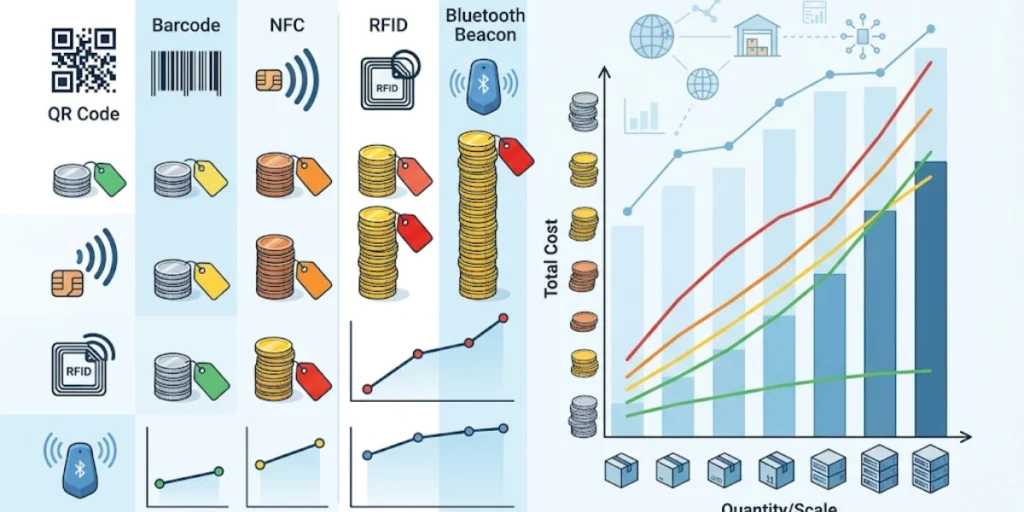
Per-unit cost is where most articles stop. But Total Cost of Ownership is a different number.
Here is rough math for a 100,000-unit deployment.
QR Code on packaging:
- Production: $0 (added to existing print run)
- Platform fee: a few hundred dollars per month
- Year-one total: under $5,000
NFC tags on packaging:
- Tag cost: $10,000 to $20,000
- Embedding and packaging redesign: $20,000 to $50,000
- Backend platform: $5,000 to $15,000 per year
- Year-one total: $35,000 to $85,000
RFID for retail anti-theft:
- Tag cost: $10,000 to $50,000
- Reader infrastructure across stores: $50,000 to $250,000
- Software and integration: $50,000+
- Year-one total: north of $100,000
The pattern is clear. QR is the cheapest by an order of magnitude. NFC makes sense when the per-item value justifies the spend, like luxury goods or pharma. RFID pays back through inventory accuracy, not consumer reach.
E. Does NFC’s higher conversion rate beat QR codes?
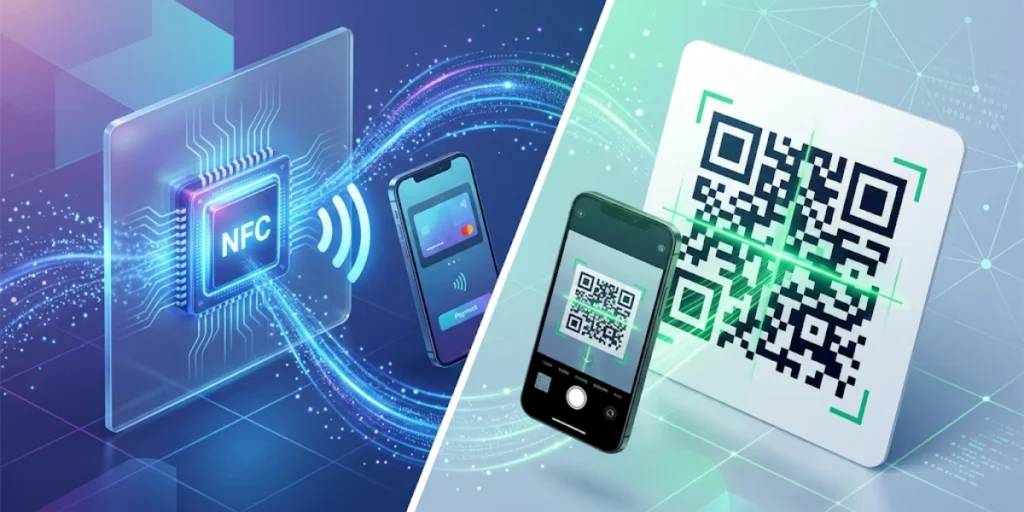
NFC’s 60 to 80% completion rate is a big number. If you are running a one-on-one sales meeting or a tap-to-tip stand at a hotel, that gap is meaningful. But here is what most NFC vendors do not tell you.
That conversion gap shrinks fast outside controlled settings. At a checkout counter with a server watching, NFC’s tap-and-go feels obvious. On a billboard at 65 mph, NFC is invisible. On packaging in a noisy supermarket aisle, NFC is invisible. The 60-80% figure assumes the user knows the tag is there.
QR Codes have a visibility advantage. The black-and-white square is a CTA on its own. NFC needs signage, training, or staff to point at it.
So the better question is not “which has higher conversion.” It is “which one will my user see?” For most public-facing print and packaging, that is QR. For high-touch one-on-one moments, that is NFC.
F. Which QR code alternative fits your industry?
A quick, honest take, by use case.
Consumer Packaged Goods (CPG): QR Codes win. Sunrise 2027 makes it official. Print a GS1 Digital Link QR Code. Connect it to a product page with allergen information, recycling details, and a loyalty hook. Add NFC support only to premium SKUs that require authentication.
Pharma: GS1 DataMatrix is mandatory in the EU and de facto everywhere else. Add a consumer-facing GS1 QR Code on the outer pack for patient education and adherence.
Luxury: Use both. NFC inside the product for authentication and a digital product passport. QR on the box and care card for marketing and resale verification. The Aura Consortium model is now the standard.
Retail: RFID for back-of-house inventory and theft. QR Codes for in-store marketing, reviews, and loyalty signups.
Hospitality: QR for menus, Wi-Fi, room service, and reviews. NFC at the front desk for a premium feel with repeat guests.
Events and field sales: NFC business cards for one-on-one. QR Codes on signage and badges as a fallback. Pair them.
Audio and voice: Short branded URLs. QR Codes do not work in podcasts.
The pattern: QR Codes do the heavy lifting. NFC is the upgrade for premium moments. Other alternatives are tools for specific jobs, not main-stage choices.
G. What do teams get wrong when picking QR code alternatives?
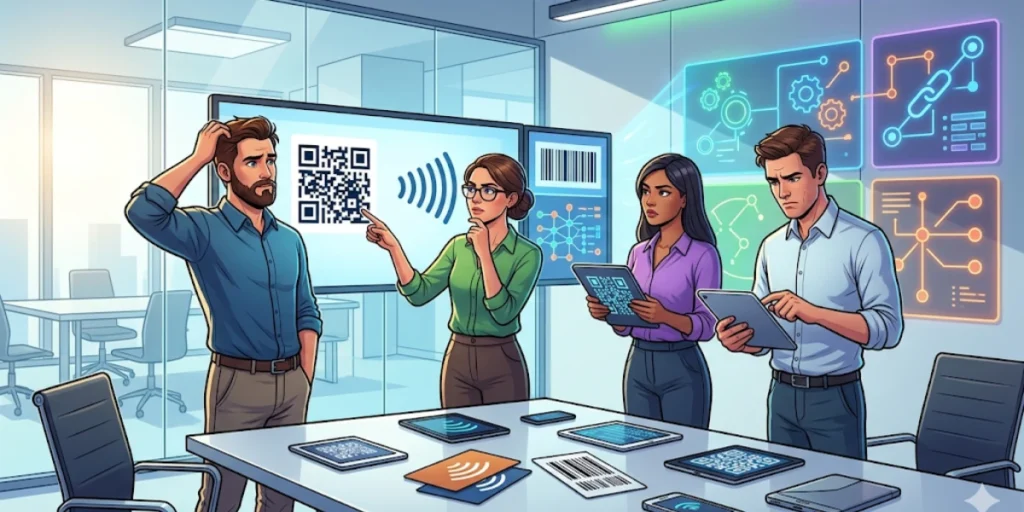
A few patterns I see again and again.
1. Picking NFC first because it feels modern
Brand managers fall in love with the tap. Then they realize their target audience is on Android budget phones, and the NFC reach number is closer to 1 in 4 in their actual market. The campaign quietly underperforms.
2. Treating QR Codes as a one-off tool
A QR Code is not a print decision. It is a marketing channel. If you do not build it on a platform that lets you change the destination, track scans, and avoid quishing, you are setting yourself up to either lose data or get burned.
3. Ignoring the security cost of free tools
QR phishing incidents grew fivefold between August and November 2025, per Uniqode’s data. The average enterprise loss per quishing incident is over $1 million, per Keepnet’s analysis. Executives face 40 to 42 times as many QR-based attacks as the average employee. A QR Code generated by a free service with a generic short domain name looks identical to a malicious one. A branded short URL on your own domain does not.
4. Underestimating the GS1 Sunrise 2027 timeline
Brands that wait until 2027 will scramble. Pilots take 12 to 18 months. P&G and PepsiCo started years ago. If you sell on a retail shelf in 2027, your packaging needs a GS1 QR Code by then. That decision belongs in your 2026 plan, not your 2027 one.
H. How do you pick the right QR code platform?
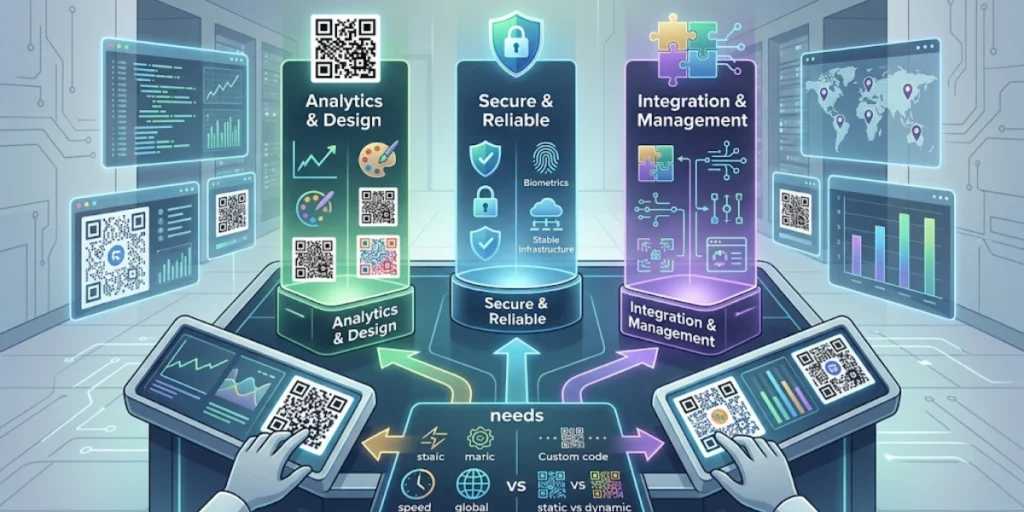
If you have made it here, QR is probably the right tool for most of what you are doing. The next question is which platform to build on.
This is where I will say what I know best. I work at Scanova. We help brands like American Express, Amazon, and Cisco run QR Code campaigns at scale.
The reason I bring it up: not all QR platforms are built for production. Many are toy generators dressed up as marketing tools. For a wedding seating chart or a one-off poster, that is fine. For anything with brand stakes or a packaging run that has to last five years, you need:
- Dynamic codes you can edit without reprinting
- Real-time analytics: scan count, location, time, device
- Branded short URLs on your own domain, to fight quishing
- GS1 Digital Link support for packaging
- Bulk creation, team access, and role-based controls
- API and CRM integrations
- SOC 2, ISO 27001, GDPR for enterprise risk teams
If your platform misses these, you will feel it the day a code you printed two years ago either expires, breaks, or shows up in a security audit.
If you want to test something built for that bar, Scanova has a free trial. No credit card. You can spin up a tracked, branded, dynamic QR Code in five minutes.
Final thoughts
QR Codes have been called dead more times than I can count. Yet the global QR Code market stood at about $13 billion in 2025 and is on track to reach $33 billion by 2030, according to Mordor Intelligence. Sunrise 2027 will accelerate that curve.
But growth alone does not mean QR is the right tool for every project. NFC, RFID, BLE, and data matrix all have a place. The skill is knowing which one fits the job.
For most marketers, QR is still the default. NFC is the upgrade for premium moments and authentication. The rest are niche.
Pick the tool that meets your users where they are. Then make the experience after the scan worth their time. That is where most brands fall short, and where the next wins live.