Best GS1 QR Code Generators for 2027: Top Platforms for Sunrise Readiness
In a nutshell: A GS1 QR Code generator creates QR Codes using the GS1 Digital Link standard, encoding product data such as GTIN, batch number, serial number, and expiration date in a single scannable code. Unlike regular QR Codes, they work with both retail scanners and consumer smartphones, enabling packaging traceability and product engagement. I tested five tools, including Scanova. All support GS1 Digital Link creation, but only some offer dynamic management, analytics, resolver flexibility, and branding for real packaging deployments. Scanova provides the most balanced option for brands preparing for GS1 Sunrise 2027.
Major retailers, including Walmart, Target, and Carrefour, have committed to reading 2D barcodes at checkout by the end of 2027. According to GS1’s Sunrise 2027 programme, this transition affects virtually every consumer goods brand that sells through modern retail, and the deadline is two years away. The question is no longer whether to adopt GS1 QR Codes, but which tools give you the most control over the transition.
This guide covers what the best GS1 QR Code Generators are, why retailers are requiring them, and which generation platforms are best suited for real packaging deployments.
“The shift to 2D barcodes at retail checkout will allow brands to surface supply-chain, traceability, and consumer engagement data from a single scan — something 1D barcodes have never been able to deliver.” — Sanjay Sharma, Head of GS1 India – Standards & Digital Solutions, GS1 India. Source: GS1 India – “GS1 Digital Link: Empowering Product Info via QR Codes” (2025).
A. What is a GS1 QR Code, and why does it matter?

A GS1 QR Code is a standardized QR Code built using the GS1 Digital Link framework.
Instead of storing a simple URL, the code embeds structured product identifiers inside a web-based format that both machines and humans can interpret.
A typical GS1 Digital Link looks like this:
Each section represents an Application Identifier (AI) defined by GS1.
For example:
| Identifier | Meaning |
| 01 | GTIN |
| 10 | Batch number |
| 17 | Expiration date |
| 21 | Serial number |
This structure allows the same barcode to serve multiple purposes.
A retail scanner reads the GTIN for checkout.
A supply chain system reads batch or serial numbers.
A consumer smartphone opens the product page or digital experience associated with the product.
GS1 India reported 33,275 barcode subscriptions in the fiscal year 2024-25. This figure marks growth from 31,506 subscriptions in 2023-24, as detailed in their official annual report. Source: gs1india.org.
B. Why Retailers Are Pushing for 2D Barcodes?
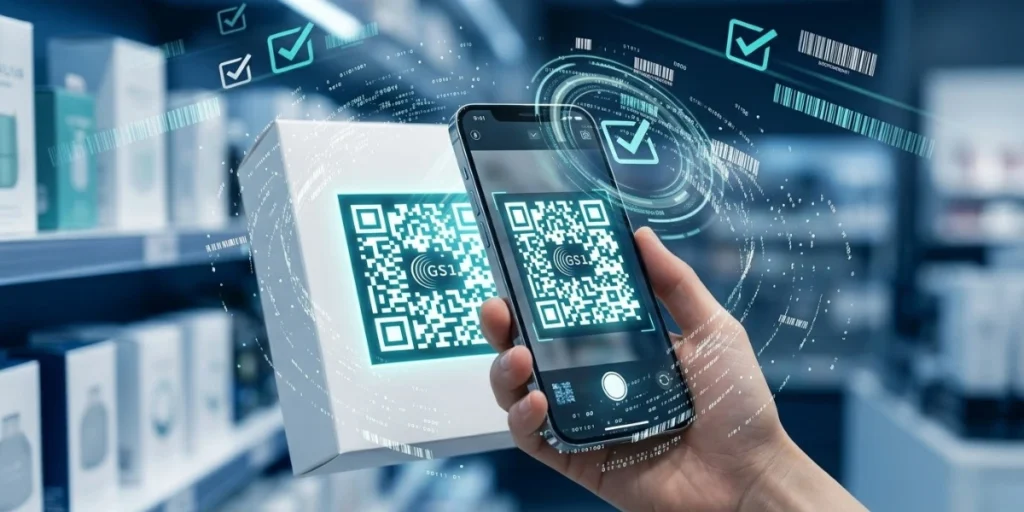
The push toward GS1 QR Codes isn’t just about technology. It’s a response to real operational challenges.
Retailers increasingly need access to more detailed product information at checkout.
For example:
Food retailers must track expiration dates to reduce food waste.
Pharmaceutical companies must track batch numbers and serialization for regulatory compliance.
Manufacturers must identify specific production runs during product recalls.
Traditional barcodes can’t store this level of detail.
They only encode the product identifier, forcing retailers to retrieve additional information from external databases.
GS1 QR Codes solve this problem by embedding structured product identifiers directly into the barcode.
This allows a single scan to reveal:
- product identity
- batch number
- expiration date
- serial number
- traceability information
C. How did I test these tools (Best GS1 QR Code Generators)?
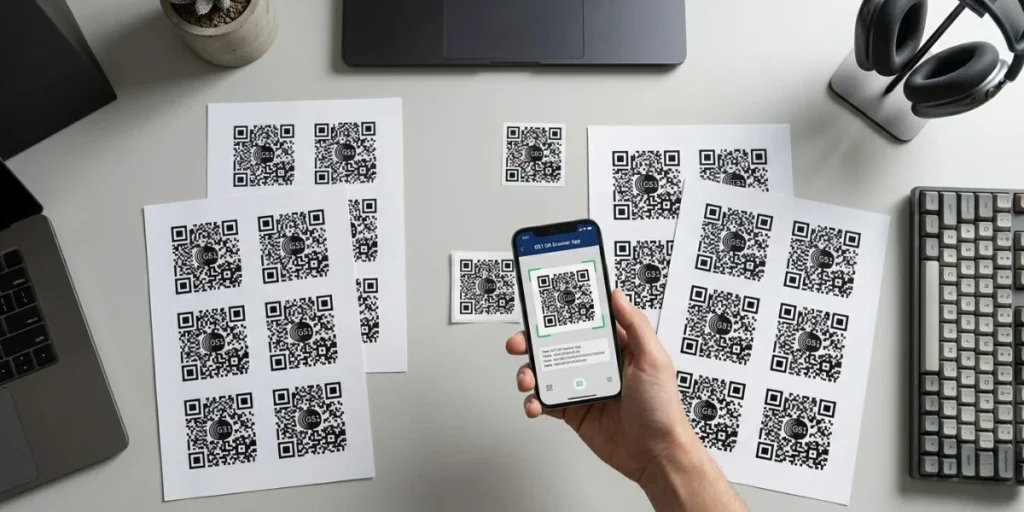
I tested each tool by generating GS1 QR Codes using real-world scenarios, adding GTIN, batch number, and expiry data, then verifying GS1 Digital Link compliance.
I also evaluated bulk generation, resolver flexibility, analytics, branding, export quality, and pricing based on actual packaging deployment needs.
Rather than relying on product pages or feature lists, I evaluated each platform using a practical GS1 Digital Link implementation workflow similar to what a brand would follow when preparing QR Codes for real product packaging.
For each tool, I attempted to generate a GS1 QR Code containing a GTIN, along with additional identifiers such as a batch number and expiration date, and verified that the resulting Digital Link structure complied with GS1 standards.
Beyond basic generation, I also assessed factors that affect real deployments: support for multiple GS1 identifiers, flexibility of the resolver used to process scans, ability to generate codes in bulk for large product catalogs, availability of scan analytics, branding options for packaging design, export formats suitable for print production, and overall pricing transparency relative to the capabilities offered.
These criteria reflect the practical requirements companies face when implementing GS1 QR Codes across retail, supply chains, and consumer engagement workflows. The results of this testing are summarized in the comparison table below.
D. Which are the best GS1 QR Code Generators for you?
Companies need more than a basic generator, and after testing across real packaging workflows, Scanova stands out as the most balanced GS1 QR Code platform for both traceability and marketing. It supports full GS1 Digital Link compliance, dynamic updates, custom resolver control, bulk generation, and analytics, making it the best choice for brands preparing for Sunrise 2027.
Companies deploying GS1 QR Codes typically need more than just a generator. In real packaging environments, teams must manage large SKU catalogs, maintain resolver control for years after printing, update product information dynamically, and sometimes track how consumers interact with packaging.
The platforms below approach these needs differently. Some prioritize marketing analytics, others focus on supply-chain infrastructure, while a few attempt to balance both.
1. Scanova: Best Balanced Platform for Packaging, Marketing, and Traceability
Scanova is a QR Code management platform designed for long-term QR deployments, which makes it particularly well-suited for GS1 Digital Link implementations.
The platform supports standards-compliant GS1 Digital Link generation, allowing identifiers such as:
- GTIN
- Batch or lot numbers
- Expiration dates
- Serial numbers
to be encoded directly within the Digital Link structure.
A key consideration for GS1 QR Codes is resolver control, because the QR Code URL printed on packaging may remain in circulation for several years. Scanova supports three resolver approaches:
- The official GS1 resolver
- Scanova’s resolver infrastructure
- Custom domain resolvers controlled by the brand
Using a custom domain is particularly valuable for manufacturers because it ensures long-term ownership of product URLs even if the platform infrastructure changes.
The platform also supports dynamic GS1 QR Codes, allowing companies to update product pages, regulatory information, or marketing campaigns without reprinting packaging.
From a scalability perspective, Scanova supports bulk QR Code generation through spreadsheet uploads and API integrations. This enables manufacturers to generate QR Codes for hundreds or thousands of SKUs in a single workflow.
The platform also includes scan analytics, which can reveal:
- Geographic distribution of scans
- Device types used for scanning
- Scan frequency over time
For brands using QR Codes on packaging, these insights help measure how consumers interact with products after purchase.
Pricing Model
Scanova follows a SaaS subscription model with tiered plans, where higher tiers unlock features such as advanced analytics, API access, and enterprise capabilities.
Pros
- Strong GS1 Digital Link support
- Custom domain resolver control
- Dynamic QR Codes for post-print updates
- Bulk generation and API automation
- Marketing analytics and campaign features
- High-resolution export formats for packaging
Cons
- Some advanced features require higher-tier plans
- Enterprise integrations may require onboarding support
Best For
- Brands preparing for GS1 Sunrise 2027
- Companies combining traceability and consumer engagement
- Manufacturers managing large product catalogs
Not Ideal For
- Developers who only need a lightweight barcode SDK
- Organizations looking for a basic free generator
“The difference between a GS1 QR Code that just ‘works’ and one that actually delivers value comes down to control and flexibility. If you can manage how the code resolves for POS systems, supply chain data, or consumer engagement, you unlock its full potential. Most basic generators stop at encoding data, but platforms that support dynamic updates, resolver options, and analytics are what make GS1 QR Codes viable for real-world packaging and Sunrise 2027 readiness.” — Siddharth Pangtey, Product Manager at Scanova
2. QR TIGER
QR TIGER is widely used in marketing environments where QR Codes are part of promotional campaigns.
The platform supports GS1 Digital Link generation, enabling identifiers such as GTINs and batch numbers to be encoded in QR Codes.
One of QR TIGER’s notable features is conditional routing, which allows scan destinations to change depending on factors such as:
- Scan location
- Device language
- Number of scans
- Time of day
This can be useful for global campaigns where the same QR Code appears on packaging distributed across multiple regions.
For example, a scan in one country could open a localized product page, while scans in another region could display a different language version.
QR TIGER also provides scan analytics dashboards that track geographic activity and device types.
However, the platform offers limited resolver flexibility, which may be a consideration for brands that want full control over the domains embedded in their packaging QR Codes.
Pricing Model
QR TIGER operates on a subscription-based SaaS model, with different tiers unlocking dynamic QR capabilities, scan limits, and analytics features.
Pros
- Conditional scan routing features
- Marketing campaign tools
- Built-in analytics dashboards
- Accessible entry-level plans
Cons
- Resolver flexibility is limited
- GS1 features are not the platform’s primary focus
- Packaging workflow tools are less robust
Best For
- Marketing campaigns using QR Codes on packaging
- Regional campaigns requiring dynamic routing
Not Ideal For
- Companies needing long-term packaging infrastructure
- Advanced supply-chain traceability deployments
3. Uniqode
Uniqode (formerly Beaconstac) focuses on organizations that need QR Codes integrated into enterprise software ecosystems.
The platform supports GS1 Digital Link generation and provides features such as:
- Bulk QR Code creation
- Team collaboration tools
- Role-based permissions
- Enterprise security controls
Where Uniqode stands out is its integration ecosystem.
The platform integrates with several enterprise systems, including:
- Salesforce
- HubSpot
- Google Analytics
- Marketing automation tools
These integrations connect scan activity with CRM systems and customer data platforms, enabling organizations to incorporate QR interactions into broader marketing and analytics workflows.
However, the platform’s cost structure and feature depth tend to align more closely with enterprise deployments, which may make it less suitable for smaller organizations.
Pricing Model
Uniqode follows an enterprise-oriented subscription model, where pricing tiers scale based on features, integrations, and usage.
Pros
- Strong enterprise integrations
- Advanced analytics capabilities
- Team collaboration features
- Security and compliance controls
Cons
- Higher complexity compared to simpler generators
- Pricing model is typically geared toward larger organizations
Best For
- Enterprise organizations
- Teams integrating QR data into CRM or marketing automation systems
Not Ideal For
- Small businesses
- Companies primarily focused on product traceability workflows
4. TEC-IT
TEC-IT approaches GS1 QR Codes from a technical and developer-centric perspective.
Rather than building a marketing platform, the company develops barcode generation software and SDKs used by developers to embed barcode functionality into their applications.
TEC-IT tools support GS1 Digital Link QR Codes as well as a wide range of other barcode standards.
Developers can generate QR Codes programmatically using:
- Barcode SDK libraries
- APIs
- Label printing software integrations
Because the platform primarily functions as a barcode engine, it does not include features typically found in marketing QR code platforms.
For example, TEC-IT does not provide:
- Scan analytics dashboards
- Dynamic QR Code management
- Marketing routing rules
Instead, the software is commonly embedded inside custom inventory systems, warehouse applications, and labeling tools.
Pricing Model
TEC-IT typically uses a license-based pricing model, where organizations purchase software licenses or developer SDKs rather than subscribing to a QR management platform.
Pros
- Highly accurate barcode generation
- Full GS1 standard support
- Developer-friendly APIs and SDKs
- Reliable for technical barcode systems
Cons
- No built-in analytics
- No dynamic QR Code routing
- Requires development resources
Best For
- Developers building custom supply-chain systems
- Companies embedding barcode generation into internal applications
Not Ideal For
- Marketing teams
- Businesses wanting a plug-and-play QR management platform
5. Digital Link Connexum
Digital Link Connexum focuses specifically on GS1 Digital Link infrastructure and supply-chain traceability.
One of its distinctive capabilities is the generation of child QR Codes linked to a single GTIN.
This allows manufacturers to generate multiple QR Codes representing:
- Different production batches
- Regional product variations
- Packaging sizes or weights
- Expiration dates
For example, a manufacturer could create separate QR Codes for different production batches of the same product, enabling batch-level traceability across the supply chain.
This type of architecture is especially useful in industries such as:
- Food manufacturing
- Pharmaceuticals
- Industrial manufacturing
However, Connexum includes fewer marketing-oriented features than broader QR platforms.
Branding tools, analytics dashboards, and campaign management features are limited because the platform focuses primarily on traceability workflows rather than consumer engagement.
Pricing Model
Connexum typically operates under an enterprise or infrastructure-based pricing model, often customized based on deployment requirements and integration needs.
Pros
- Designed specifically for GS1 Digital Link infrastructure
- Supports batch-level QR generation
- Strong supply-chain traceability features
Cons
- Limited branding and marketing tools
- Minimal analytics features
- Enterprise-focused deployment complexity
Best For
- Supply-chain traceability systems
- Manufacturers implementing GS1 infrastructure
Not Ideal For
- Marketing campaigns
- Consumer engagement through QR Codes
“Evaluating GS1 QR Code tools for your packaging line? Our team has tested these platforms firsthand. Book a free consultation to get a platform recommendation tailored to your SKU volume and resolver requirements.”
E. Which GS1 QR Code Generator Should You Choose?
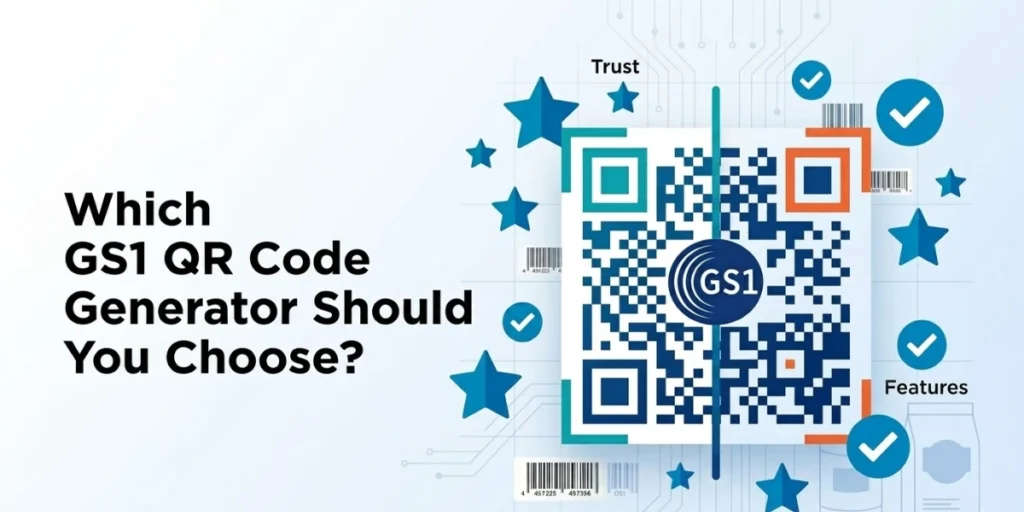
The right GS1 QR Code generator depends largely on what role the QR Code will play in your product ecosystem.
Some platforms are designed primarily for marketing campaigns, while others focus on barcode infrastructure or supply-chain traceability. A few attempt to combine both.
Here is a simple way to think about the options.
Choose Scanova if you need a balanced packaging solution
If your goal is to implement GS1 QR Codes on product packaging while also enabling consumer engagement, platforms that combine compliance, resolver flexibility, and analytics are the most practical.
Scanova fits this use case well because it combines:
- GS1 Digital Link support
- custom domain resolver control
- dynamic QR Code updates
- bulk SKU generation
- scan analytics
This combination makes it suitable for brands preparing for GS1 Sunrise 2027, where a single QR Code must support both retail scanning and consumer interactions.
Choose QR TIGER if your priority is marketing campaigns
QR TIGER is often used in marketing-driven QR deployments, particularly when companies want to route scans to different destinations depending on location or device.
If your primary goal is running regional campaigns or promotional experiences, this routing type can be useful.
However, for long-term packaging infrastructure, companies may also want to consider resolver ownership and scalability.
Choose Uniqode if you need enterprise integrations
Organizations that manage QR Codes across multiple departments may benefit from platforms that integrate with CRM systems, marketing automation tools, and analytics platforms.
Uniqode focuses on this enterprise integration layer, making it a reasonable choice for companies that want QR scans connected to broader customer data systems.
Choose TEC-IT if you are building a custom barcode system
TEC-IT is best suited for developers building barcode functionality directly into software applications.
Rather than offering a QR management platform, the company provides barcode SDKs and APIs that can be embedded into inventory systems, warehouse tools, or labeling software.
Choose Digital Link Connexum if your focus is supply-chain traceability
Connexum focuses specifically on GS1 Digital Link infrastructure, making it relevant for manufacturers implementing batch-level traceability or complex product hierarchies.
Its architecture is designed around identifier management and resolver infrastructure, rather than marketing analytics or consumer experiences.
A Practical Perspective
For most brands preparing for GS1 adoption, the goal is not simply generating QR Codes. The challenge is managing QR Codes across the entire product lifecycle, from packaging and supply-chain tracking to post-purchase engagement.
Platforms that combine GS1 compliance, resolver flexibility, scalable generation, and analytics tend to be easier to maintain as deployments grow.
That’s why many companies evaluating GS1 QR tools ultimately prioritize solutions that support both product traceability and consumer interaction workflows within the same platform.
For a deeper look at how GS1 Digital Link resolvers work https://scanova.io/blog/gs1-digital-link/
F. How Should You Prepare for GS1 Sunrise 2027?

Start by structuring your GS1 identifiers, preparing product data, and updating packaging to support dual barcodes during the transition.
Then choose a reliable platform like Scanova to generate, manage, and test GS1 QR Codes at scale with resolver control and analytics.
Sunrise 2027 aims to transition retail from traditional 1D barcodes to 2D barcodes, such as GS1 QR Codes, that store more product data.
A GS1 QR Code can encode identifiers such as GTINs, batch numbers, expiration dates, and serial numbers in a single barcode.
Different systems interpret the same code differently: POS scanners read the GTIN for checkout, supply chain systems use batch data for traceability, and smartphones open product information pages.
This shift allows companies to replace multiple barcode systems with one standardized code while improving traceability, recall accuracy, and consumer access to product information.
Step 1: Ensure Product Identifiers Are Structured Correctly
Before implementing GS1 QR Codes, companies must ensure their product identifier system is correctly structured.
This typically involves:
- obtaining a GS1 Company Prefix
- assigning GTIN numbers to products
- maintaining a database of product attributes
Without this foundation, generating GS1 Digital Link QR Codes becomes difficult because the identifiers encoded in the QR Code must correspond to valid GS1 identifiers.
Step 2: Prepare Product Data Infrastructure
GS1 QR Codes often link to digital product pages that provide detailed information when consumers scan the code.
This means companies need a system for managing product data such as:
- ingredients
- regulatory information
- sustainability certifications
- product documentation
Many organizations create structured product pages or databases that act as the destination for these scans.
Step 3: Update Packaging Design
Packaging will need to accommodate 2D barcodes.
In many cases, companies will temporarily include both:
- the existing UPC barcode
- a GS1 QR Code
This dual-barcode approach ensures compatibility with retail systems that have not yet upgraded their scanners.
Packaging teams should consider:
- QR Code placement
- minimum print size
- contrast and scannability
- quiet zone margins
Testing codes with real scanners before large print runs is critical.
Step 4: Verify Retail Scanner Compatibility
Retail checkout scanners must support 2D barcode reading.
Modern image-based scanners can read:
- QR Codes
- DataMatrix codes
- traditional barcodes
However, older laser scanners used in some stores can only read 1D barcodes.
Retailers are gradually upgrading their systems, but during the transition period many brands will continue printing both barcode types.
Companies should coordinate with retail partners to confirm scanner compatibility and rollout timelines.
Step 5: Implement a GS1 Digital Link Resolver
A resolver determines what happens when a GS1 QR Code is scanned.
The resolver can redirect scans to different destinations depending on the scanning device.
Examples:
- POS scanner → GTIN data for checkout
- smartphone → product information page
Resolvers may be:
- The official GS1 resolver
- A platform-provided resolver
- A custom resolver using a brand-owned domain
Using a custom domain ensures the company maintains long-term control over the QR Code URL embedded in packaging.
Step 6: Choose a GS1 QR Code Generation Platform
Once identifiers, packaging, and data systems are prepared, companies need a platform that can generate GS1 Digital Link QR Codes.
The generator should support:
- valid Digital Link URI structures
- multiple GS1 Application Identifiers
- bulk QR Code generation
- packaging-ready export formats
Platforms that support dynamic QR Codes and analytics can also provide insight into how consumers interact with packaging.
Step 7: Test Codes Across Devices and Systems
Before deploying QR Codes on large packaging runs, companies should test them across several environments.
Testing should include:
- smartphone cameras
- retail checkout scanners
- warehouse scanners
- supply chain systems
G. Frequently asked questions: Best GS1 QR Code Generators

1. Do I need a GS1 company prefix to create a GS1 QR Code?
Yes. A GS1 QR Code must contain a GTIN (Global Trade Item Number), and GTINs are only issued through a GS1 Company Prefix. Without this prefix, your QR Code will not comply with the GS1 Digital Link standard or work correctly with retail checkout systems.
2. Will GS1 QR Codes replace traditional UPC barcodes?
Not immediately. During the Sunrise 2027 transition period, most products will carry both a UPC barcode and a GS1 QR Code to ensure compatibility with older checkout scanners. Over time, as retailers complete their scanner upgrades, GS1 QR Codes are expected to become the primary format for consumer packaged goods.
3. Can GS1 QR Codes track scans?
GS1 QR Codes themselves do not track scans — the GS1 Digital Link standard only defines how product identifiers are encoded. Tracking depends on the platform used to generate them. Platforms that support dynamic QR Codes can record scan locations, device types, and scan frequencies.
4. Are GS1 QR Codes required by law?
No. GS1 Sunrise 2027 is an industry-led initiative, not a legal requirement. However, as retailers upgrade their checkout systems to support 2D scanning, adoption is expected to grow significantly across consumer packaged goods categories.
Ready to create GS1 QR Codes that are actually deployment-ready? With Scanova, you can generate GS1 Digital Link QR Codes, manage how they resolve across use cases, and update content even after printing. You also get scan-level insights like location, device, and time, so you can track real-world performance. It’s built for teams preparing for Sunrise 2027, not just basic code generation. Start free at scanova.io, no credit card required.
