Marvel QR Code: A Complete Guide

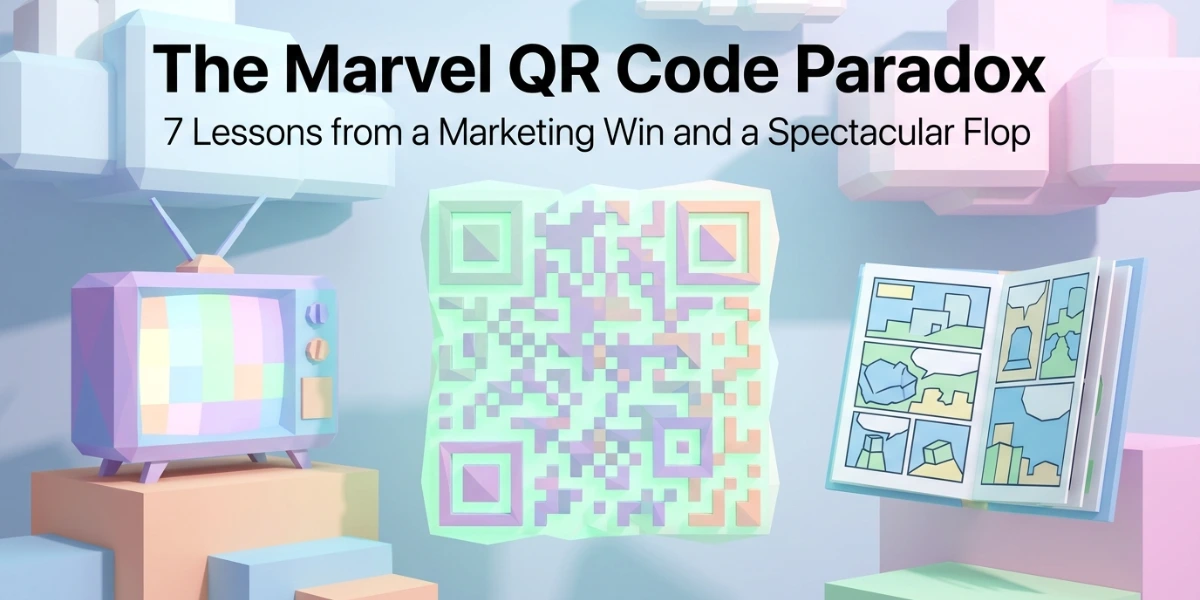
In a nutshell (TL;DR): A Marvel QR Code is a scannable square hidden inside a Marvel show, comic, or event. Most lead to a free digital comic. Marvel started the trend in WandaVision, grew it through Moon Knight, Ms. Marvel, and She-Hulk, then moved it into print comics in 2024. The Disney+ version worked. Marvel's VP of Marketing reported over 2.5 million hits and 750,000 comic downloads from the Moon Knight campaign. The print version failed. Fans thought Marvel was selling incomplete books, and the codes were pulled within months. This guide covers every known code, why one version worked, and seven lessons you can apply to your own campaigns.
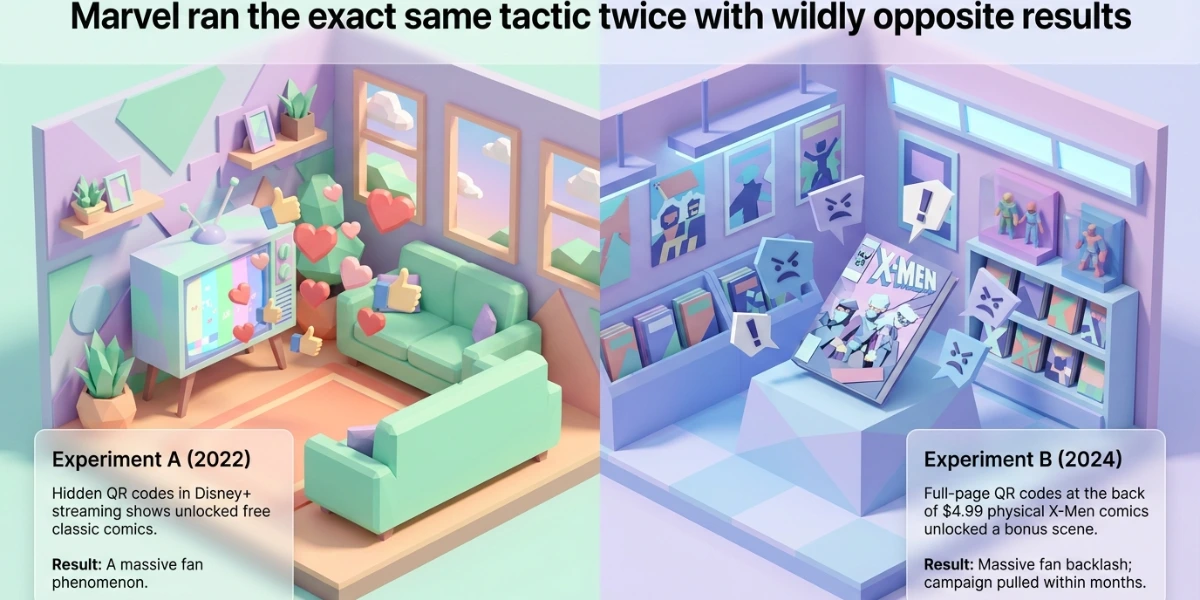
Here is the short version. Marvel ran the same tactic twice and got two opposite results.
In 2022, Marvel tucked tiny QR Codes into the background of Disney+ episodes. Fans found them, scanned them, and got free comics. Reddit threads lit up. The press covered it. It became a fan sport.
In 2024, Marvel put a full-page QR Code at the back of its X-Men comics. Same idea. Same free bonus content. This time fans accused the publisher of hiding pages behind a phone screen. The codes were gone within a few months.
That gap is the whole story. And it matters far beyond comics. QR scanning is no longer a niche habit. Bitly's first-party data shows scans grew in every world region from 2024 to 2025, led by Europe at 42%. Meanwhile, roughly 102.6 million people in the US are expected to scan a QR Code in 2026, per eMarketer figures.
I build and study QR campaigns at Scanova. I have watched brands copy the Marvel playbook and get it half right.
So in this guide I map every Marvel QR Code I could verify, pull the quotes from the people who ran it, and break down what separated the win from the flop.
A. What Is a Marvel QR Code?
A Marvel QR Code is an ordinary QR Code with a Marvel destination behind it. Nothing about the technology is special. The square is the same square on a menu or a parcel.
What changed was the placement.
Marvel treated the code as a hidden object inside the story. It sat on a locker door, a poster, a prison uniform, or a laptop screen. You had to spot it first. Then you had to pause the episode and scan it.
Most codes opened a free digital comic on Marvel's website or in Marvel Unlimited, the publisher's subscription app. Some opened a teaser page. A few, like the ones in WandaVision, never resolved to anything at all.
So a Marvel QR Code is really two things at once. It is a link. It is also a reward for paying attention.
B. Where Can You Find Marvel QR Codes?
Here is the clearest list I could assemble from reporting, fan documentation, and Marvel's own pages.
|
Where it appeared |
What the scan unlocked |
|
WandaVision (2021) |
Non-working codes. Still unexplained by Marvel |
|
Moon Knight (2022) |
Free classic comics, including Werewolf by Night #32 and #33 |
|
Ms. Marvel (2022) |
Free Kamala Khan issues, including Ms. Marvel (2014) #1 |
|
She-Hulk: Attorney at Law (2022) |
Savage She-Hulk #1, later She-Hulk (2004) #1, plus Marvel Unlimited previews |
|
Comic-Con displays |
Merchandise and sign-up pages |
|
X-Men "From the Ashes" comics (2024) |
A one-page bonus scene on Marvel.com |
|
Giant-Size Spider-Man #1 (2025) |
A 616 Day surprise at marvel.com/616 |
Three of these deserve more detail.
The Moon Knight codes set the pattern. The first one appeared about five minutes into episode one, on a museum wall. Scanning it opened Werewolf by Night #32, the issue where Moon Knight first appears. A new code followed on a storage locker in episode two. Not every episode had one, which kept people hunting.
The She-Hulk codes added a twist. One code sat on Emil Blonsky's prison uniform. Fans could see it, but the shot never held still enough to scan it. That mystery alone generated weeks of discussion.
The X-Men codes moved the idea into print. That is where things broke, and I cover it in detail below.
C. Why Did Marvel Put QR Codes in Its Disney+ Shows?
The goal was never the scan. The goal was the comic reader.
Marvel Entertainment's VP of Marketing, Jessica Malloy, explained the thinking at a Bitly event. Talking about Moon Knight, she said the aim was about bringing him into the MCU for new viewers while also activating fans who already knew the character's comic history.
That is a bridge problem. A streaming viewer and a comic buyer are often two different people. Marvel wanted one to become the other.
The results, as reported by Bitly, were strong. The hidden codes drove over 2.5 million visits to the Moon Knight landing page and more than 750,000 bonus comic downloads. Marvel then tested the same idea at live events, including Comic-Con displays that let fans buy merchandise from a queue.
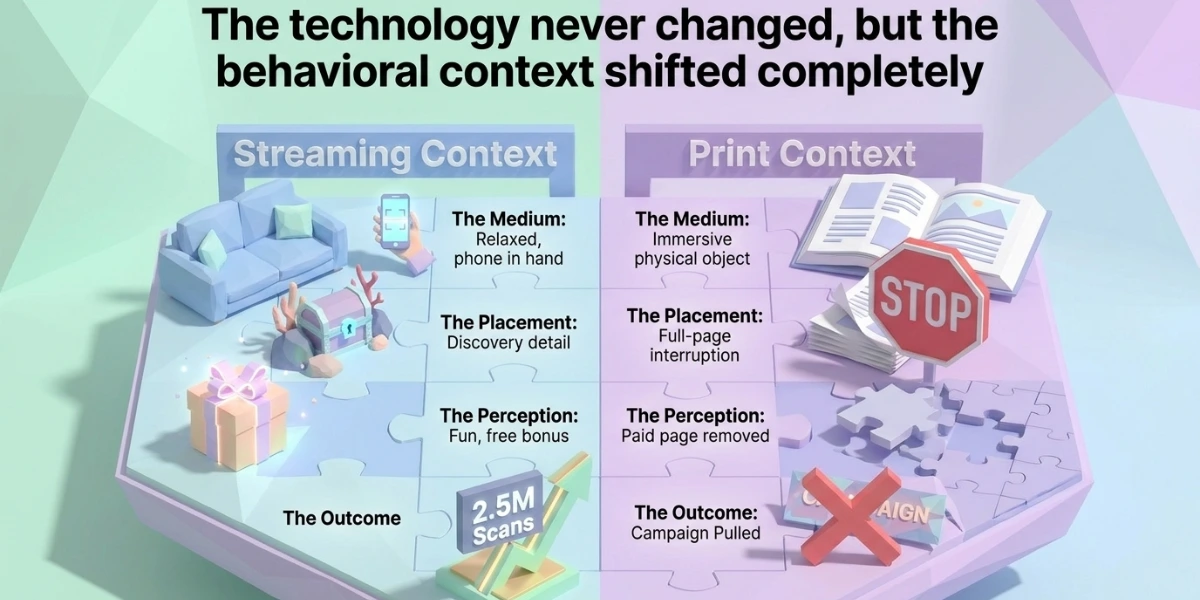
What made it work was restraint. The codes were optional. Nobody lost anything by missing one. The reward was free. And the scan happened at home, on a couch, with a phone already in hand.
D. What Happened With the X-Men QR Code Controversy?
In July 2024, Marvel relaunched its X-Men line under the banner "From the Ashes." Starting with X-Men #1, a full-page QR Code appeared at the back of several issues. Scanning it opened a one-page bonus scene on Marvel's site.
Fans were not pleased.
The complaint was simple. Readers paid cover price and saw a QR Code where a page of art should be. Many assumed Marvel had cut content from the book and moved it online.
Marvel VP Executive Editor Tom Brevoort pushed back on his Substack. He said, "It was a bonus page to begin with, an extra page"</a>, and that the issue was never trimmed to make room for it. He added that hiding the page until release day helped stop early spoilers, since some shops break street date.
He later went further, telling a reader that "none of those X-Books was missing a page". He also noted the bonus pages would be folded into the eventual collected editions.
The explanation did not land. By November 2024, the QR Codes had quietly stopped appearing in X-Men titles.
So why did the same tactic fail here?
Three reasons stand out to me:
- The context changed. A TV viewer is relaxed. A comic reader is holding a physical object they paid for. Asking them to stop and pick up a phone breaks the experience.
- The code looked like a replacement, not a bonus. A full page devoted to a square reads as a swap, even when it is not. Perception beat the facts.
- Collectors think in decades. A comic sits in a bag for thirty years. A URL does not. More on that further down.
E. What Is the Marvel 616 Day QR Code?
Marvel did not abandon the idea. It just changed the frame.
In June 2025, Marvel placed a QR Code in Giant-Size Spider-Man #1 ahead of 616 Day, the June 16 celebration named after Earth-616. The code pointed to marvel.com/616, a page that stayed dark until the morning of the event. Bleeding Cool reported that it went live just after 06:16 ET and teased a reveal twelve hours later.
This version drew far less anger. The reason is worth noting.
The 616 Day code was tied to an event, not to a story page. Nobody felt a comic was incomplete. The code was a door to a party, not a missing chapter.
F. Did Marvel Try This Before QR Codes?
Yes. And the earlier attempt tells you a lot.
In 2012, Marvel launched the Marvel AR app at SXSW, built with the AR firm Aurasma. Marvel called it "the first major publisher to bring augmented reality to comic books".
Readers pointed a phone at a small AR symbol printed in an issue. Bonus videos, scripts, and artwork appeared on screen.
It was ambitious. Marvel produced around 1,500 unlockables in the first two years. The app was updated in 2014. Then it was shut down and pulled from app stores around 2015.
Every one of those printed AR symbols became a dead mark on a page.
That is the real lesson behind Marvel's QR experiments. The code is never the risk. The system behind the code is.
G. What Can Marketers Learn From Marvel's QR Codes?
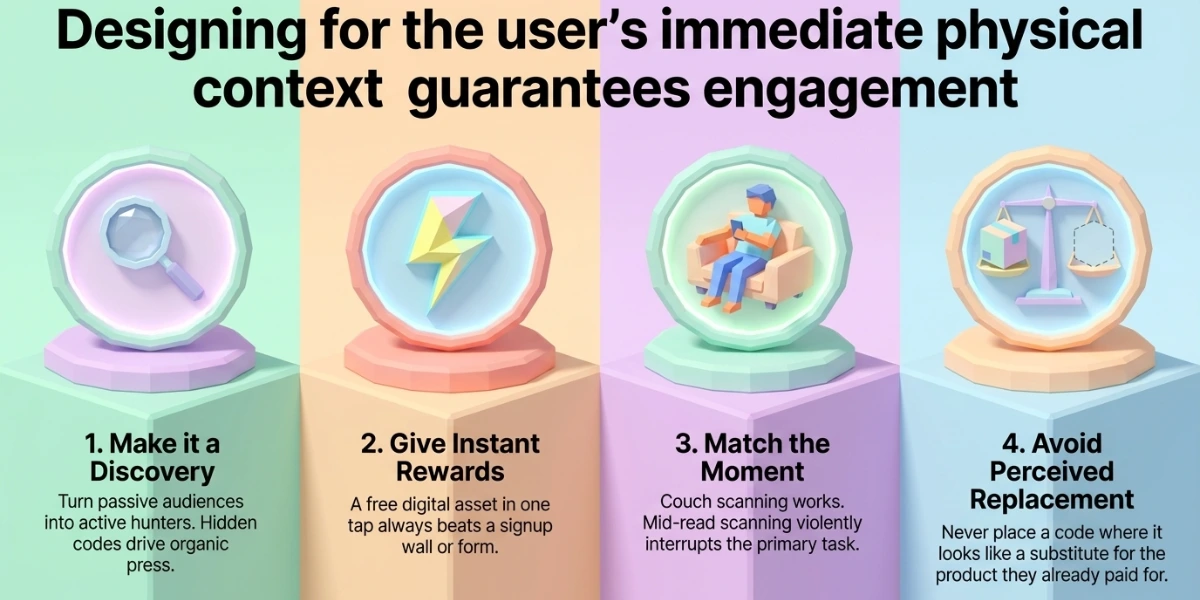
Here are the seven takeaways I keep coming back to.
|
Lesson |
What Marvel proved |
|
1. Make the scan a discovery |
Hidden codes turned viewers into hunters and drove free press |
|
2. Give the reward instantly |
A free comic in one tap beats a form or a signup wall |
|
3. Match the code to the moment |
Couch scanning works. Mid-read scanning does not |
|
4. Never look like you removed something |
Perception of loss kills a campaign faster than any bug |
|
5. Use delayed reveals |
Locking content until launch day controls spoilers and builds urgency |
|
6. Plan for the link to outlive the campaign |
Print lasts decades. URLs do not |
|
7. Measure scans, not impressions |
Marvel could report real numbers because the codes were tracked |
Two of these need unpacking.
Lesson 3 is the one most brands miss. A QR Code competes for attention with whatever the person is already doing. On a couch, a phone is already within reach. In the middle of a comic page, the phone is an interruption. Ask yourself what the person is holding when they see your code. If the answer is "the thing I am selling them," think twice.
Lesson 6 is the one that costs money later. Printed codes outlive campaigns, staff, and sometimes whole marketing stacks. If the destination is hard-coded into the pattern, you cannot fix it. If the destination is managed, you can. That is the practical difference between static and dynamic QR Codes, and it decides whether your code is an asset or a liability in year three.
H. How Do You Build a Marvel-Style QR Code Campaign?
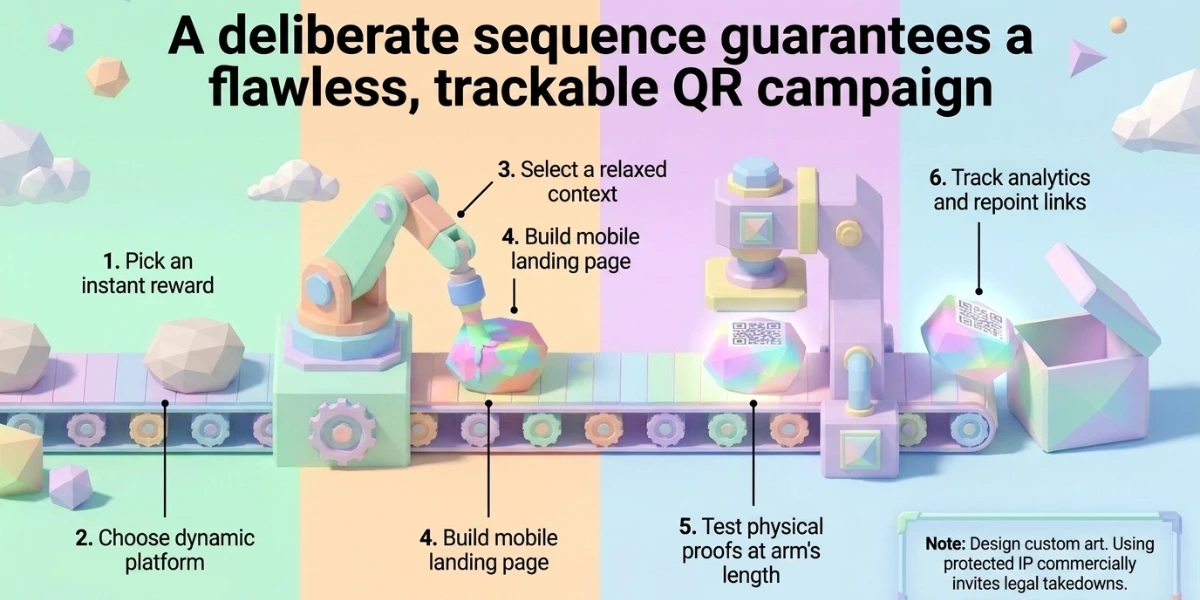
You do not need Marvel's budget. You need its structure. Here is the process I would follow.
- Pick one reward worth a scan. Free beats discounted. Instant beats delayed. A chapter, a track, a template, a sample.
- Choose a dynamic code. You will want to change the destination later. Every serious campaign does. Our guide to the best dynamic QR Code generator covers what to look for.
- Decide where the person will be standing. Seated and relaxed is best. Mid-task is worst.
- Hide it, but not too well. Marvel's codes were findable in a single pause. If people need a tutorial, the game is over.
- Build a real landing page. Mobile-first. One action. No popup before the reward.
- Set a reveal time if timing matters. A code that goes live at launch creates a moment. Marvel used this twice, successfully both times.
- Test the scan at actual size and distance. Print a proof. Scan it at arm's length, in bad light, with an older phone.
- Track scans, locations, and times. Then feed that back into the next drop.
A note on tooling. At Scanova, we build dynamic codes with editable destinations, scan analytics, and bulk creation, which is what a multi-episode or multi-issue campaign actually needs. Bitly powered Marvel's version. Several platforms can do this well. The point is that you need a managed system, not a free one-off generator, the moment your code touches print.
I. Can You Make Your Own Marvel QR Code?
This is the question I see most often, and the honest answer has two parts.
You can make a QR Code that links to Marvel content. Linking to a public Marvel page is just linking. Fans build these for watch parties, themed invites, and collection catalogs all the time.
You cannot put Marvel branding on it and use it commercially. Marvel characters, logos, and names are protected trademarks owned by Marvel and Disney. A QR Code styled with Iron Man's armor is fan art at best. Selling it, printing it on merchandise, or using it to promote a business invites a takedown.
Several AI QR art sites offer "Marvel" templates. Treat those as personal-use novelty, not a commercial asset. If you want a superhero feel for a real campaign, design your own character and palette. You get the same visual energy with none of the legal exposure.
For personal use, the practical path is simple. Create a plain QR Code pointing to the Marvel page you want. Then style the frame and colors yourself, keeping strong contrast so it still scans.
J. Why Do Some Marvel QR Codes Stop Working?
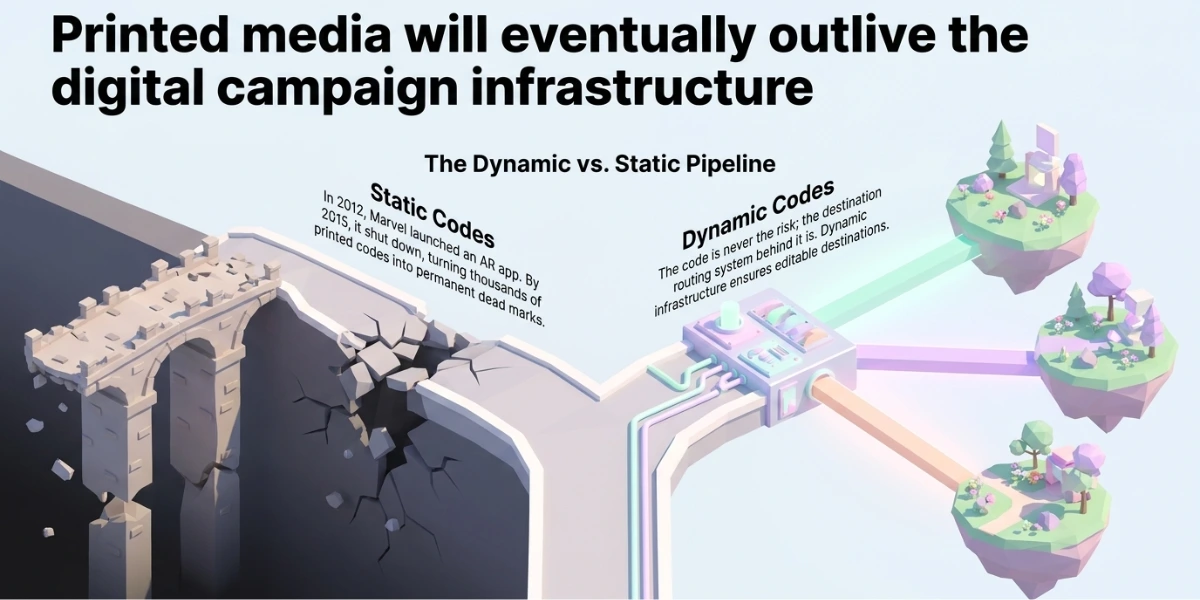
Because a QR Code is only as alive as its destination.
The square itself never expires. The pattern printed in a 2022 comic will still decode in 2042. What changes is what sits at the other end of the link.
Three things break Marvel codes over time:
- The promotion ends. Free comic windows close. The code still works, but the page says no.
- The page moves. Site migrations retire old URLs. Static codes cannot follow.
- The platform shuts down. This is what killed the Marvel AR symbols in 2015.
One comic reader made this point in a 2024 comment thread, and it has stuck with me. Eventually Marvel stops hosting the bonus images, and the person who owns that first issue is left with a page that leads nowhere.
If you are printing codes, this is your warning. Use a dynamic code so you can repoint it. Keep the destination on a domain you control. And review your live codes once a year, the same way you would audit old backlinks. Our QR Code statistics roundup has more on how long printed codes actually stay in circulation.
K. FAQs: Marvel QR Code
1. What is a Marvel QR Code?
It is a QR Code placed inside a Marvel show, comic, or event that usually unlocks a free digital comic or a hidden reveal page.
2. Where was the first Marvel QR Code?
Non-working codes appeared in WandaVision in 2021. The first working ones showed up in Moon Knight in 2022.
3. Do Marvel QR Codes still give free comics?
Some do. Many promotions have ended, so a code may still scan but land on an expired page.
4. Why did fans get angry about the X-Men QR Codes?
Readers believed Marvel had moved a story page online. Marvel said the page was always a free bonus, but the perception stuck.
5. Are Marvel QR Codes still used in comics?
Not in the X-Men line. Marvel removed them in late 2024 but has used one-off codes since, including for 616 Day in 2025.
6. How do I scan a Marvel QR Code?
Open your phone's camera, point it at the code, and tap the link. Most iPhones and Android phones support this natively, with no app needed.
7. Can I create a Marvel-themed QR Code for my business?
No. Marvel characters and logos are trademarked. Use original artwork instead.
My Takeaway
Marvel ran the cleanest QR experiment in modern marketing, and it published both results for free.
The win came from treating the code as a gift the audience had to find. The loss came from placing that same gift where it looked like a theft. The technology never changed. Only the context did.
So before you print a single code, ask three questions. What is the person holding when they see it? Does this feel like a bonus or a bill? And will this link still work when the campaign is long over?
Get those right, and a QR Code stops being a square on a page. It becomes the shortest distance between a fan and the thing they already wanted.