Weatherproof QR Code Labels: How to Make Them Last Outdoors

In a nutshell (TL;DR): Weatherproof QR Code labels last outdoors when four layers hold up together. You need a synthetic or metal base, fade-resistant ink, a clear matte top layer, and an outdoor-rated glue. Skip paper and direct thermal prints. Use polyester or metal for jobs that run for years. Design the code for damage with high error correction and a generous size. Then use a dynamic QR Code, so you can change the link without replacing the label.
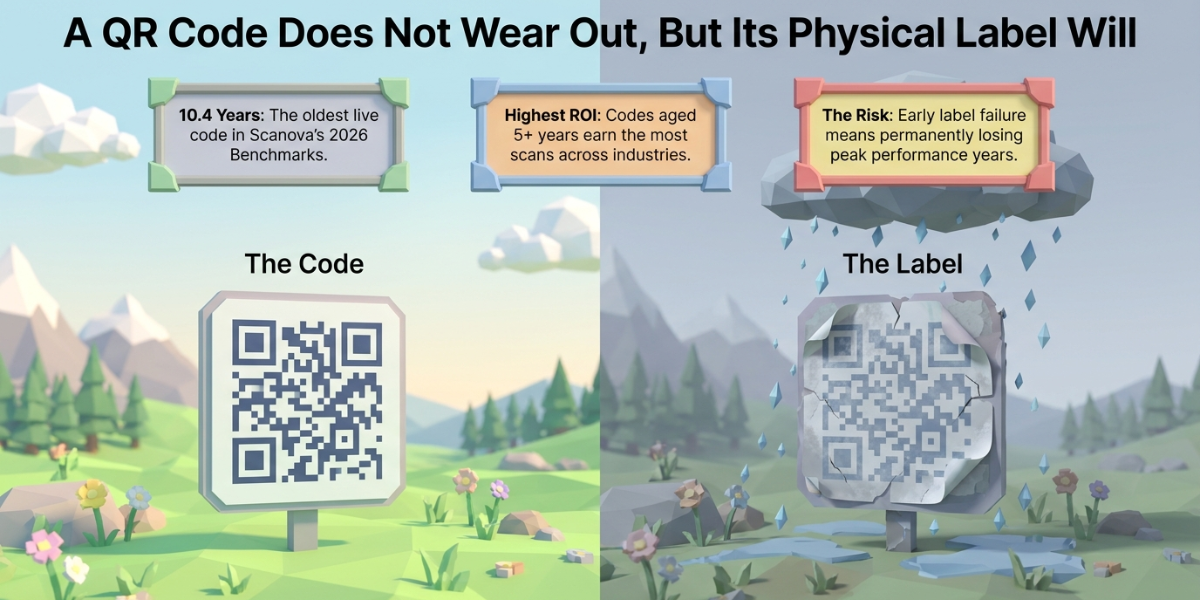
A QR Code does not wear out. The label it sits on does.
Weatherproof QR Code labels solve this with a tough base, fade-resistant ink, a clear top layer, and glue made for the outdoors. Get all four right, and a code can keep scanning for years.
That matters more than most people think. In Scanova's 2026 QR Code Benchmarks, the oldest live code has been scanning for 10.4 years. In three of the four industries studied, codes aged five years or more earn the highest scan rates. So a printed code often does its best work late in its life.
Most outdoor labels do not last that long. Brady, a major maker of industrial labels, says many outdoor ID labels "fade, shrink, crack or fall-off after a couple of years."
The code can keep earning for a decade, while the label may quit in two. When the label quits, those best years go with it.
In this guide, I cover which materials and print methods last, and the design specs that keep a worn code readable. Then I show how to make, apply, and test your labels. I also cover tampering, the outdoor risk most guides skip.
A. What Are Weatherproof QR Code Labels?
They are QR Code labels built to stay scannable through rain, sun, heat, cold, and handling. The protection comes from four layers working together, not from one special sticker.
- Base: vinyl, polyester, polypropylene, or metal. Never plain paper.
- Ink: pigment ink, a resin ribbon, UV-cured ink, or a laser mark. Never dye ink.
- Top layer: a clear laminate or coating that blocks UV light and water.
- Glue: a permanent adhesive rated for outdoor temperatures and your surface.
Watch the wording when you shop. "Waterproof" only promises the label survives water. "Weatherproof" should also cover sun, heat, cold, and wear. If a listing only says waterproof, ask how the print handles sunlight.
For indoor sticker ideas, Scanova's guide to QR Code stickers covers the basics.
B. Why Do QR Code Labels Fail Outdoors?
Outdoor labels fail in six ways. Sun fades the ink, water creeps in at the edges, and grit wears the surface. Heat and cold cycles weaken the glue, glare blocks scans, and people tamper with codes.
Avery Dennison, one of the largest label material makers, puts the stakes simply. Once an outdoor label peels, fades, or turns unreadable, the information on it is lost.
The tricky part is that failure is slow. A faded code rarely dies on day one. It scans slowly first, then only on some phones, then not at all. People give up long before the code is fully dead. So you lose scans before anyone reports a problem.
That is why I plan outdoor labels in years, not weeks. Pick the build for the full time the sign or asset will stay in place.
C. Which Materials and Print Methods Last Longest Outside?
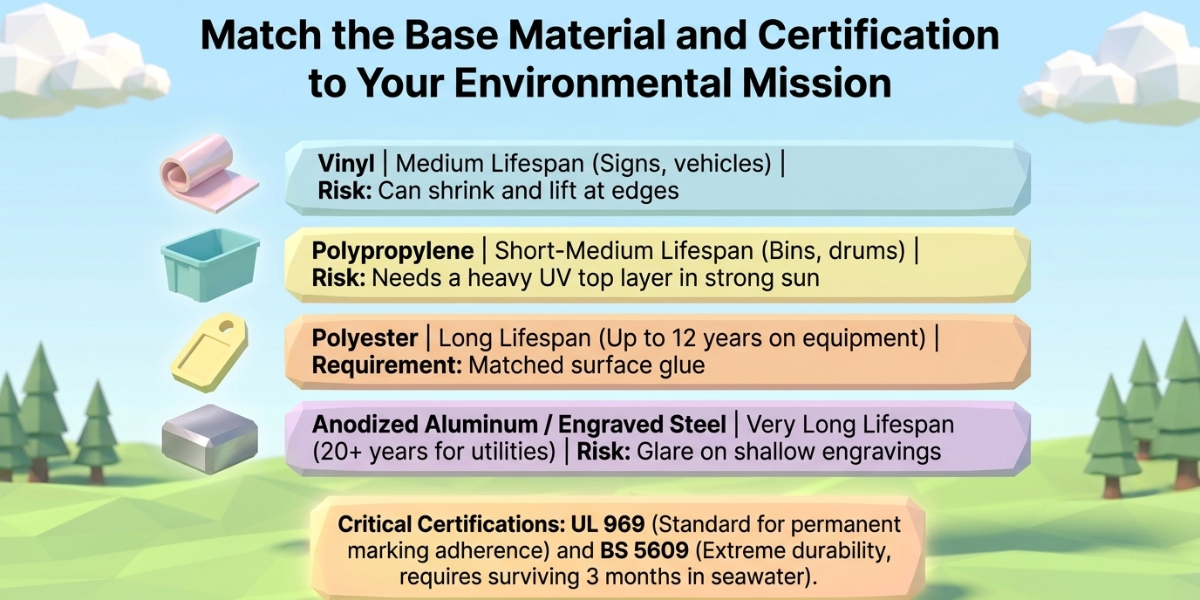
Polyester and metal last longest, followed by vinyl. Paper fails fast outdoors, even with a laminate. How you print matters as much as what you print on.
|
Base material |
Outdoor life |
Best for |
Watch out for |
|---|---|---|---|
|
Paper + laminate |
Short |
One-day events, pop-ups |
Water wicks in through any gap in the seal |
|
Vinyl |
Medium |
Signs, windows, vehicles, curved surfaces |
Can shrink and lift at the edges |
|
Polypropylene |
Short to medium |
Bins, drums, short outdoor runs |
Needs a top layer in strong sun |
|
Polyester |
Long |
Equipment, meters, asset tags |
Needs a glue matched to the surface |
|
Anodized aluminum |
Very long |
Utilities, fixed assets, harsh sites |
Higher cost per tag |
|
Engraved stainless steel |
Very long |
Marine, chemical, heavy wear |
Shallow engraving can scan poorly in glare |
Exact ratings come from each maker's data sheet. Brady rates one polyester label for up to 12 years outdoors, based on accelerated weathering tests. Camcode says its anodized aluminum tags last over 20 years outdoors. Treat these as lab ratings, not promises. Your climate decides the real number.
Print methods that survive the sun
- Direct thermal: never use it outside. Zebra notes these prints fade over time and resist heat and light poorly.
- Thermal transfer with a resin ribbon: Zebra's pick for labels that face rain and sun.
- UV-cured inkjet: what pro sticker printers use. The ink hardens the moment it prints.
- Laser engraving or photo-anodizing: the image sits in or under the surface, so nothing can peel off.
Standards worth asking for
UL 969 covers how well labels hold up for permanent marking. BS 5609 is tougher. Certified drum labels must stay stuck and readable after three months in seawater.
One trap: "BS 5609 compliant" may only mean the base material passed. The printed label is tested separately under Section 3, so ask for that certificate.
Len Holtkamp is global segment director for durables at Avery Dennison. As he put it, "No one-size-fits-all test can work for outdoor labels." Test the full build on the real surface.
D. How Do You Design a QR Code That Survives the Weather?
Design the code to tolerate damage. Use high error correction and print it bigger than the minimum. Keep a clear border, and use a dark code on a light, matte background.
- Error correction Q or H. QR Codes can rebuild missing data. Denso Wave, which invented the QR Code, suggests level Q or H where codes get dirty. More on the levels in Scanova's error correction guide.
- Size up. A common rule is scan distance divided by ten. Outdoors, I go one size bigger to leave room for wear. Scanova's minimum size guide has the math.
- Keep the quiet zone. Leave a clear border at least four modules wide. Nothing should touch the code.
- Dark on light, matte finish. Black on white is the safest pair. Glossy film throws glare in sunlight and blocks scans.
- Shorter link, bigger squares. A dynamic code holds a short redirect link. Less data means fewer, larger modules, and large modules survive scratches better.
- Export as vector. SVG, EPS, or PDF files keep edges crisp at any size. Scanova exports vector and high-resolution files.
- Keep logos small. A logo uses part of the error correction you may need later for damage.
- Add a fallback. Print a short call to action and your web address with the code. A frame makes this easy.
E. How Do You Make and Apply Outdoor QR Code Labels?
Match the build to how long the label must last, and test it first. Then apply it to a clean, dry, warm surface. Many early failures come from rushed application, not bad material.
- Set the lifespan. For a few months, laminated vinyl can work. For years, use polyester or metal. For marine or chemical sites, look for BS 5609.
- Create a dynamic code. Then export it as a vector file.
- Pick DIY or pro. For short jobs, print on vinyl with pigment ink or a laser printer. Then seal it with matte laminate that wraps past every edge. For long jobs, order from a label printer and test samples first. Camcode, for one, mails free sample kits for testing on site.
- Test before you stick. Wet the label. Scan it in bright sun and in shade, on two phones, at three angles, from the real distance.
- Apply it right. Clean the surface with isopropyl alcohol. 3M warns that surfaces below 41°F (5°C) can stop its label glue from bonding fully. Press from the center out, and let it set before rain hits.
- Check it on a schedule. Scan it every few months, or watch your scan data for a sudden drop.
F. Should Outdoor QR Codes Be Static or Dynamic?
Use a dynamic QR Code for almost any outdoor label that points to a web page. A durable label can outlive the page it links to. A dynamic code lets you change the link without touching the label.
Picture a 12-year polyester tag on a water pump. The maintenance page will likely move at least once in that time. With a static code, the link is printed into the pattern, so the tag becomes scrap. With a dynamic code, you update the link once, and every tag in the field is fixed.
Scan data adds an early warning. If a sign that gets steady scans drops to zero, the label has probably faded, peeled, or been covered.
I work at Scanova, so treat this as a disclosure. Its dynamic QR Codes let you edit links after printing and track scans by time, place, and device. Its Health Center (Standard plans and up) lists codes with setup problems, like an expired schedule or an unverified domain.
One honest catch: a dynamic code needs an active account. If it lapses, the redirect stops. Static codes still suit data that never changes, like a serial number.
G. How Do You Stop People From Tampering With Outdoor QR Codes?
Make tampering obvious and make your real code easy to trust. Outdoor codes are easy targets, because anyone can stick a fake on top.
Alvaro Puig, a consumer education specialist at the FTC, warned of scammers "covering up QR Codes on parking meters with a QR Code of their own." NBC San Diego reported nearly 150 meters hit in Redondo Beach.
- Use tamper-evident label stock that shows a "VOID" pattern when peeled.
- Print or engrave the code into the sign itself where you can.
- Put your brand and web address beside the code, so a swapped sticker looks wrong.
- Inspect high-risk spots often, and watch scan data for odd patterns.
H. Where Are Outdoor QR Code Labels Used Most?
Anywhere a code lives outside, gets wet, or gets handled a lot.
- Equipment and asset tags: crews scan for manuals, service logs, and parts.
- Fire hydrants and utilities: wasserkarte.info links hydrant signs to each hydrant's record in its app.
- Parks, trails, and campsites: maps, rules, and alerts.
- Real estate and construction signs: listings, permits, and safety info.
- EV chargers, bike racks, and transit stops: help, payments, and timetables.
- Chemical drums and marine gear: the BS 5609 crowd.
Manufacturing is where long-life labels earn their keep. In Scanova's manufacturing benchmarks, 93 accounts run 18,182 live codes, mostly for documents, asset tracking, and product ID. Parts-lookup codes there post a 96% active rate.
I. FAQs: Weatherproof QR Code Labels
1. Will a QR Code work if you laminate it?
Yes. Laminating protects the code from water and scuffs. Use a matte laminate, since glossy film can throw glare that blocks scans. Seal it past every edge so water cannot creep under.
2. Are waterproof QR Code stickers the same as weatherproof ones?
Not always. Waterproof means the sticker survives water. Weatherproof should also cover sun, heat, cold, and wear, so ask about UV resistance before you buy.
3. How long do outdoor QR Code labels last?
It depends on the build and the climate. Laminated paper is a short-term fix. Polyester and metal tags often carry maker ratings of 10 years or more.
4. What size should an outdoor QR Code be?
Start with scan distance divided by ten, then go a size up for wear. A code scanned from 1 meter away should be at least 10 cm wide.
5. Can I make waterproof QR Code stickers at home?
Yes, for short jobs. Print on vinyl sticker paper with a pigment inkjet or laser printer, then seal it with matte laminate. For jobs that run for years, use a pro printer with resin or UV-cured ink.
What's the Smartest Way to Make Outdoor QR Codes Last?
Treat the label and the link as two parts with two lifespans. Build the label for the weather it will face, with the right base, ink, top layer, and glue. Then use a dynamic code, so the link can change while the label stays put.
If you are planning outdoor labels now, start with the code. See how Scanova's Dynamic QR Codes work, export a vector file, and run the five-minute test before you print the full batch.