Edible QR Codes: How They Work and How to Make One That Scans

In a nutshell (TL;DR): Can you really put a QR Code on food? Yes. An edible QR Code sits on or inside the food, not on the packaging. Four versions exist. You can print straight onto the food, print onto an edible sheet, bake a code into 3D printed food, or drop an edible tag into a drink. Only the sheet method is buyable today, and a starter setup costs under 500 dollars. The hard part is not making the code. It is making it scan, because contrast, size, glare, and moisture decide the result. So use a dynamic code and keep the link short. Check the rules too. Edible inks must use approved color additives, and a scan cannot replace required label text. You can reprint a poster. You cannot reprint a cookie.
In 2022, researchers at Osaka University baked a QR Code inside a cookie. No sticker. No label. The code sat inside the crumb as a pattern of tiny hollow pockets. Shine a light behind the cookie, and a phone reads it.
That story stuck with me. It also left a question I could not answer. Can I put a QR Code on food today, and will the thing actually scan?
Most articles on edible QR Codes stop at the laboratory. They cover the science and skip the part you need. How do you make one? What does it cost? Which surfaces ruin a scan? What do the food safety rules say?
The demand is already here. In a peer-reviewed survey of food shoppers, 57% reported scanning a QR Code to learn more about a product. Regulators are moving in the same direction. The FDA now expects covered food businesses to keep detailed traceability records by July 20, 2028.
So I spent a week on this. I read the research papers, the FDA guidance, and the printer spec sheets. I also looked at the boring part nobody writes about, which is why a printed code fails on a curved, shiny, edible surface.
This guide is what I found. I will walk through the four types of edible QR Codes, how to make one this week, what it costs, and how to keep it readable.
A. What an edible QR Code actually is
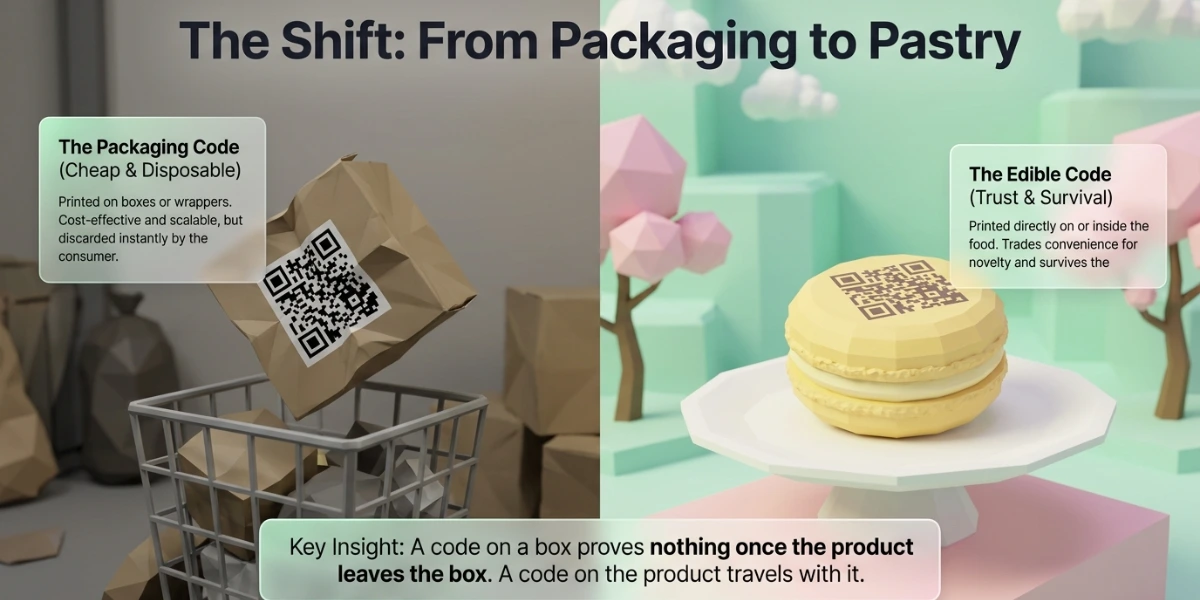
An edible QR Code is a QR Code you can eat. The code sits on the food or inside it. It is not printed on a box, a wrapper, or a label.
That single difference changes everything. A code on a wrapper can be reprinted cheaply. A code on a macaron cannot. A code on a label can be any size you want. A code on a latte has about 60 seconds before the foam moves.
So the rules shift. You trade convenience for trust and for novelty. The reward is that the code survives the moment the packaging is thrown away.
I find it helps to separate three ideas that often get mixed up:
- Packaging QR Code. Printed on the box or the label. Cheap, easy, and by far the most common.
- Edible QR Code. Printed with food-safe ink onto the food or an edible sheet. You eat it.
- Embedded edible code. Built into the structure of the food itself. Invisible until you light it up.
Most articles use "edible QR Code" for all three. That is why the topic feels confusing. The next section fixes that.
B. The four types of edible QR Codes
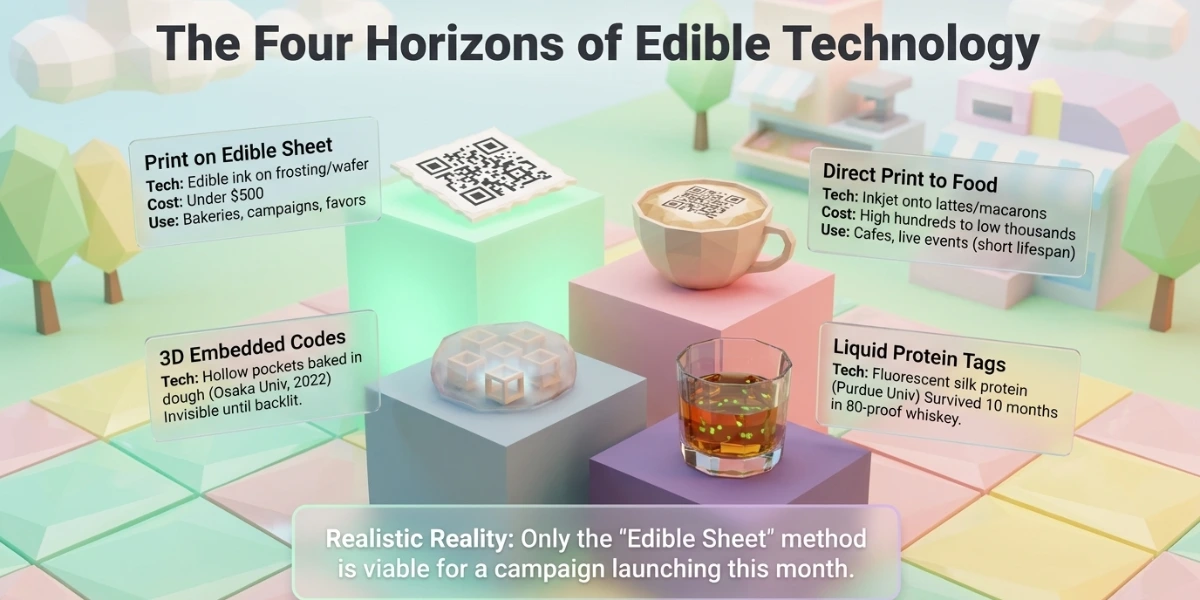
Here is the honest map. Two of these you can buy today. Two live in research labs.
Type 1. Direct print onto food
An edible inkjet printer sprays food-safe ink straight onto the surface. Think coffee foam, icing, macaron shells, or a fondant panel.
You see this most often in cafes. A latte printer drops an image onto the crema in a few seconds. Machines like these usually start in the low four figures, based on retail listings such as the Wiibox coffee printer.
Good for: cafes, dessert bars, live events, short campaigns.
Weak spot: the surface moves. Foam drifts and icing melts. Scans get short shelf lives.
Type 2. Print onto an edible sheet
This is the workhorse. You print the code onto frosting sheet, wafer paper, or rice paper. Then you place the sheet on the food.
Edible ink printing has been around for decades in cake decorating. The inks are made from food dyes. The sheets dissolve into moist surfaces, so the image looks printed on the icing itself.
Good for: bakeries, cake toppers, wedding favors, product launches, sampling campaigns.
Weak spot: you need a dedicated printer. Never use a normal office printer for this.
This is the only method most teams can realistically run this month. Section C covers it step by step.
Type 3. Codes embedded inside 3D printed food
This is the Osaka cookie. The team used food 3D printing to leave hollow pockets inside the dough. From the outside the cookie looks plain. Put a light behind it and the code appears.
Lead author Yamato Miyatake explained it simply:
"We realized that the insides of edible objects such as cookies could be printed to contain patterns of empty spaces so that, when you shine a light from behind the cookie, a QR Code becomes visible and can be read using a cellphone."
Senior author Kosuke Sato framed the point of it:
"Our 3D printing method is a great example of the digital transformation of foods, which we hope will improve food traceability and safety."
The work was published at ACM UIST 2022. It is a research prototype. You cannot buy it.
Good for: nothing yet. Watch it.
Weak spot: needs food 3D printing and a backlight at scan time.
Type 4. Edible tags you drop into a liquid
This one is my favorite. Researchers at Purdue University and Korea's National Institute of Agricultural Sciences built a tiny tag from fluorescent silk protein. You drop it into a bottle. It floats there, invisible to the eye, until an app reads it."
Young Kim, associate professor of biomedical engineering, said the target was fraud:
"Counterfeit items, such as medicines and alcohol, are big issues around the world."
His colleague Jungwoo Leem was blunter:
"Alcohol spirits are vulnerable to counterfeiting. There are a lot of fake whiskeys being sold."
The team tested the tags in 80 proof whiskey for 10 months. They kept working. Purdue also notes that 18% of UK adults report buying counterfeit spirits. The research appeared in ACS Central Science.
Good for: spirits, high value medicine, luxury liquids.
Weak spot: lab stage, needs a special reader app.
Bonus: edible codes as medicine
There is a fifth path worth knowing. At the University of Copenhagen, researchers printed the drug itself in a QR pattern onto a white edible film. The pattern is both the dose and the data.
Assistant professor Natalja Genina put it this way:
"This technology is promising, because the medical drug can be dosed exactly the way you want it to."
That work is from 2018 and has not reached pharmacy shelves. Still, it shows where personalised medicine could go.
Quick comparison
|
Type |
Can you buy it today |
Rough cost to start |
Best use |
|---|---|---|---|
|
Direct print on food |
Yes |
High hundreds to low thousands |
Cafes, live events |
|
Print on edible sheet |
Yes |
Under 500 dollars |
Bakeries, campaigns, favors |
|
Embedded in 3D printed food |
No |
Research only |
Traceability, future |
|
Edible liquid tag |
No |
Research only |
Anti counterfeiting |
C. How to make an edible QR Code this week
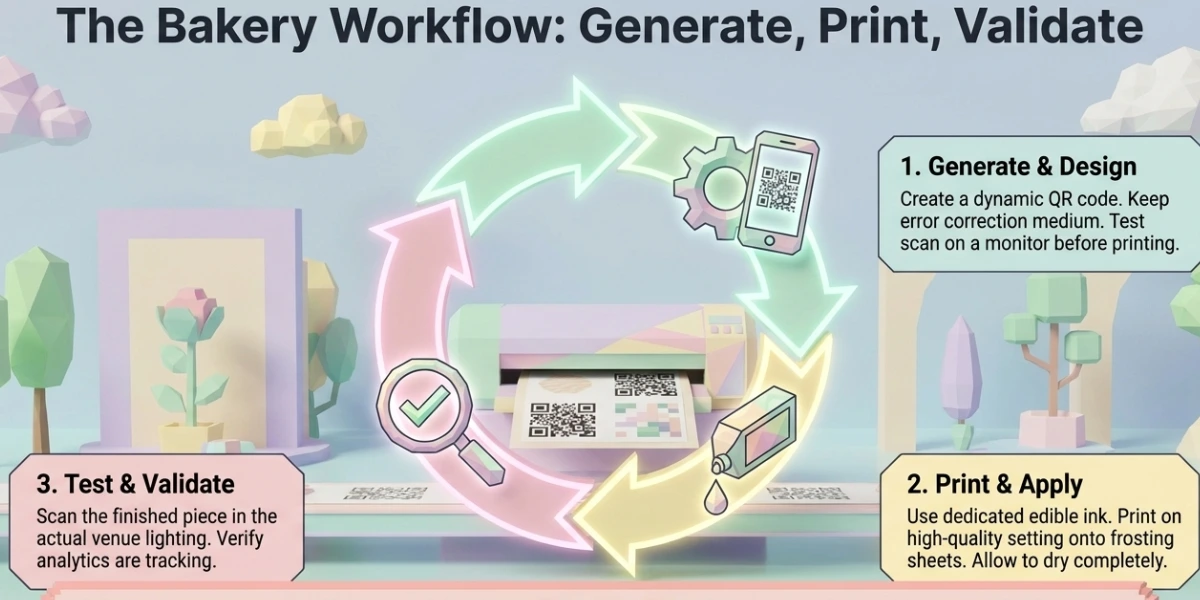
Here is the workflow I would follow. It assumes the edible sheet method. I use Scanova QR Code Generator for the code itself, so read the tool mentions as a disclosure rather than a verdict.
Step 1. Generate the code. Open Scanova QR Code Generator and create a dynamic QR Code, not a static one. I explain why in Section I. Pick the content type that matches your campaign, usually a website link for food work, then point it at the page you want people to land on. A dynamic code gives you a short redirect link, and a short link means fewer modules and bigger, cleaner squares.
Step 2. Set the design rules. Dark code on a light background. Keep the quiet zone clear. Do not put the code on a busy pattern. Skip the gradient. Scanova’s design options cover colors, a logo, eye patterns, and frames. Use them lightly here, because on food contrast beats branding every time.
Step 3. Size it properly. A common rule of thumb is the 10 to 1 ratio. For every 10 units of scanning distance, give the code 1 unit of width. A phone held 10 cm away needs a code about 1 cm wide. On food, I go bigger. A 3 cm code is a safe floor for a cupcake topper.
Step 4. Test on screen first. Scan it from your monitor with two different phones. If it fails there, it will fail on icing. This is also where a dynamic code earns its place. If the destination is wrong, you fix it in Scanova instead of reprinting the batch.
Step 5. Print it. Download the code as a vector or high resolution file, never a screen grab, because a blurry module is a failed scan. Load the frosting sheet or wafer paper. Use edible ink cartridges only. Print at a high quality setting, not draft.
Step 6. Let it dry. Give the sheet a few minutes. Wet ink smudges and a smudged module is a dead code.
Step 7. Cut and apply. Place the sheet on a dry, even surface. Press out air bubbles. A bubble under the code bends the grid.
Step 8. Test again. Scan the finished piece under the lighting where people will actually see it. A cafe is darker than your kitchen. Then confirm that scan appears in your Scanova dashboard, so you know tracking is live before the batch goes out.
I would run this whole loop once with a throwaway batch before committing to a real order.
D. What edible QR Codes cost
Costs split into equipment, consumables, and outsourcing.
Equipment. Budget edible printer bundles for home bakers "typically start around $150 to $250, including essential consumables such as edible ink cartridges and frosting sheets," according to Icinginks. Professional bundles run higher. Direct-to-drink printers sit in the low four figures.
Consumables. You pay per sheet and per cartridge. Sheets are sold in packs. Cartridges are the ongoing cost, same as any inkjet.
Outsourcing. Many edible print shops will run your artwork for you. This makes sense for one off events. It stops making sense once you print weekly.
The number nobody tells you. Your real cost is waste. Expect to lose sheets to smudges, bubbles, and failed test scans in the first few runs. I would budget 20% waste for a first project and closer to 5% after that.
For a bakery or a marketing team, the equipment is not the barrier. The barrier is the time it takes to get a reliable scan, which is the next section.
E. Why edible QR Codes fail to scan
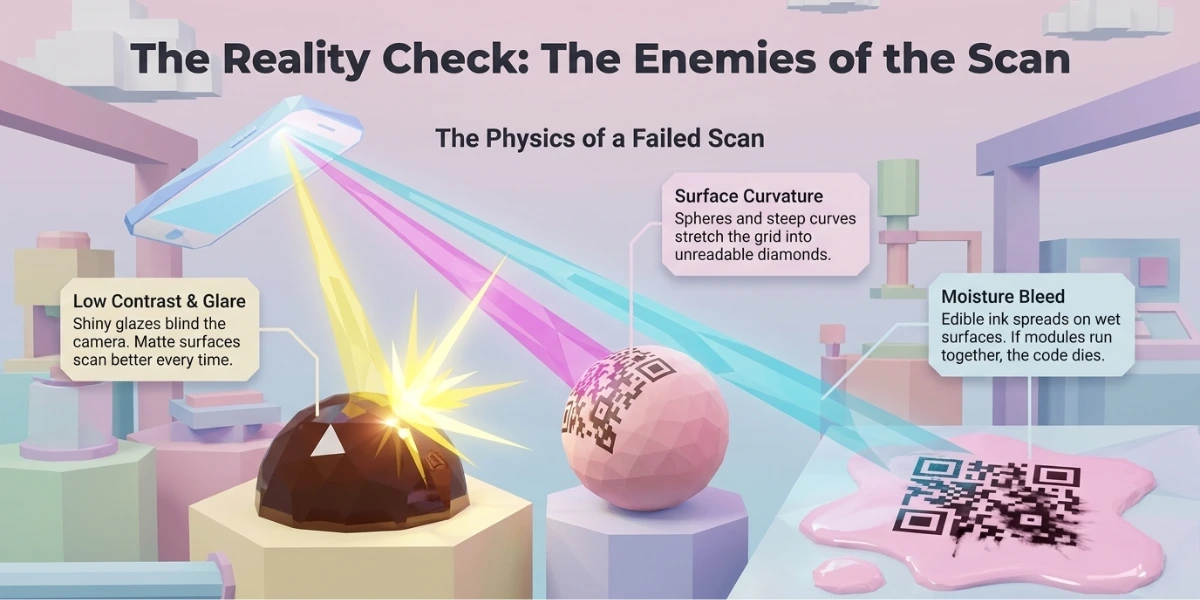
This is the part the rest of the internet skips. A QR Code is a grid of light and dark squares. Anything that blurs that contrast kills the scan.
Food is very good at blurring contrast. Here is what goes wrong.
Low contrast surfaces. Dark chocolate is the classic trap. A dark code on a dark ganache is unreadable. You need a light base under the code, or a light panel of fondant.
Glare. Shiny glazes, mirror finishes, and crema all bounce light straight back at the camera. A matte surface scans better than a glossy one every time.
Moisture bleed. Edible ink spreads on a wet surface. The modules run into each other and the grid collapses. Apply to dry surfaces, and let baked goods cool fully.
Curvature. Cupcakes, macarons, and truffles are curved. A curved code distorts the grid. Keep codes on flat or nearly flat areas, and keep them small enough to sit on the flat part.
Module size. If the individual squares get too small, the camera cannot resolve them. Shortening your URL is the cheapest fix available. Fewer characters means fewer modules and bigger squares.
Quiet zone. QR Codes need a clear margin around them. Sprinkles, piping, and crumbs in that margin will break the read.
Error correction level. Higher error correction lets a code survive damage, but it adds modules and shrinks each square. On small food surfaces I lean toward a middle setting rather than the maximum. Scanova has a useful primer on QR Code error correction if you want the detail.
Lighting at the point of scan. Restaurants are dim. Outdoor events are harsh. Test in the real environment, not at your desk.
Pre-print QA checklist
Run this before every batch:
- Is the code dark on a light background?
- Is the quiet zone empty?
- Is the printed width at least 3 cm?
- Is the destination URL as short as possible?
- Does it scan on two phones, at arm's length, in the venue's lighting?
- Is the surface dry, flat, and matte?
- Have you scanned one finished piece from the real batch?
If any answer is no, fix it before you print 500 of them.
F. The business case: traceability, fraud, and new rules
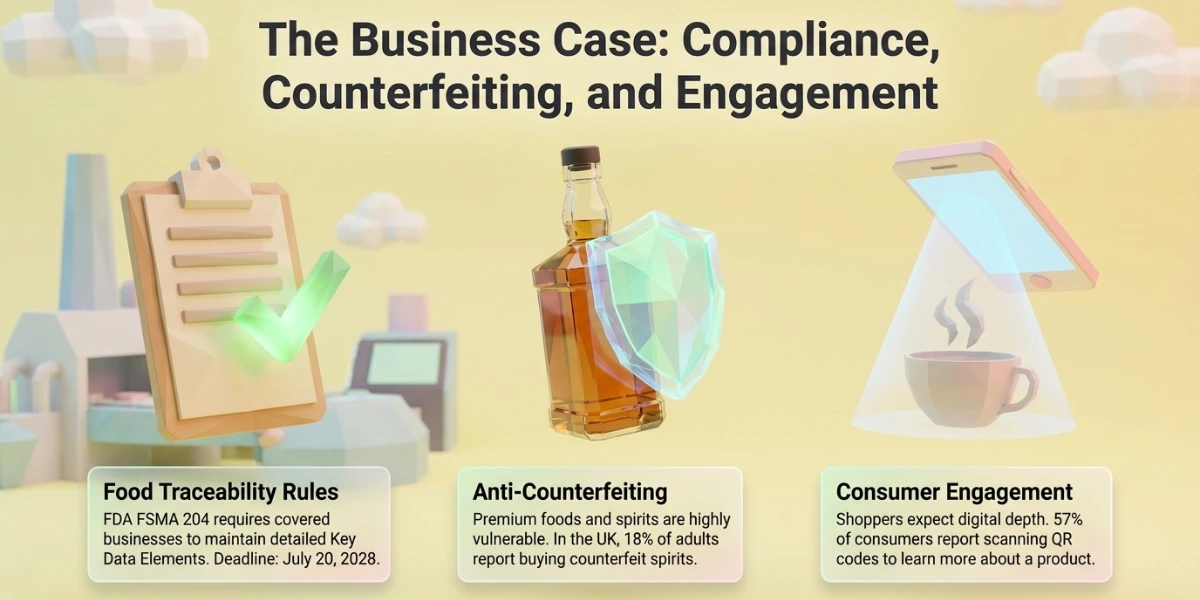
Novelty gets attention. Compliance gets budget. Three forces are pushing edible and on-product codes forward.
Food traceability rules. The FDA's Food Traceability Rule, known as FSMA 204, requires covered businesses to keep Key Data Elements for Critical Tracking Events. The compliance date was pushed to July 20, 2028 by a Federal Register notice. That is a long runway, and it is making traceability a board level topic.
The move to 2D barcodes. Retailers and brands have publicly backed the shift from the old striped barcode to QR Codes carrying GS1 standards. One code at checkout can carry a batch number, an expiry date, and a link to product information.
Counterfeiting. The World Health Organization estimates that 1 in 10 medical products in low and middle income countries is substandard or falsified. Fake spirits and fake premium foods follow the same pattern.
This is where edible codes get interesting. A code on a box proves nothing once the product leaves the box. A code on the product itself travels with it.
You can see the logic in premium food. Researchers studying edible bird's nest, one of the most counterfeited foods in Asia, have tested Bio-QR systems that bind traceability data to the product rather than the packet.
My honest read: for most food businesses in 2026, a well built packaging QR Code does 90% of this job at 5% of the cost. Edible codes earn their place where the product is high value, easy to fake, or sold without packaging.
G. Are edible QR Codes safe, and what do the rules say?
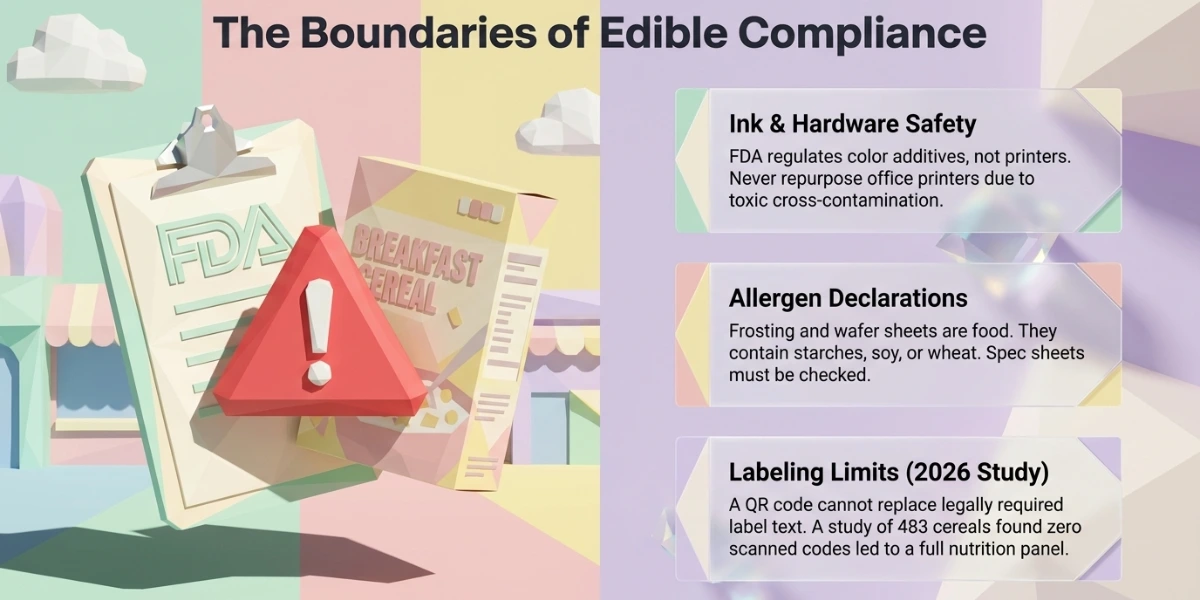
Short answer: yes, when you use the right materials. Longer answer below.
The ink. Edible inks are made from food dyes, and edible printing materials are widely sold under food-safe claims. In the US, the FDA regulates the colors themselves. Its guidance on color additives in foods is the place to start. Note the careful language. FDA regulates and lists color additives. A vendor saying "FDA approved printer" is using loose marketing language, so ask which additives the ink uses.
The printer. Use a printer dedicated to edible ink. Standard printer ink is not food. Cross contamination from a previously used office printer is a real risk.
Allergens. Frosting sheets and wafer papers have ingredients. They can contain starch, soy derivatives, or wheat depending on the product. Check the spec sheet and declare it.
Labelling limits. This one catches people out. A QR Code cannot replace information the law requires on the label. Research published in Health Promotion International and covered in April 2026 analysed 483 breakfast cereals. It found QR Codes were used "mostly as additional marketing space rather than to provide key nutrition information." Not one scanned code led to a full nutrition panel.
The lesson is simple. Use the code to add. Never use it to remove.
Security. Printed codes can be covered with a sticker carrying a different code. That attack is called quishing. On food, the sticker risk is lower, but the link risk is not. Use your own domain, not a random shortener, so people can see where they are going.
H. Edible QR Codes that actually worked
Harney Sushi, San Diego. Back in 2013, chef Robert Ruiz printed QR Codes in edible ink on rice wafers and served them on the fish. Diners scanned the wafer to see where the fish came from. Famous Campaigns reported that it brought customers back. It remains the clearest real world example I could find, and it is more than a decade old.
Cafes and latte art. Direct-to-drink printers let a cafe put a campaign code on the foam. It is short lived by design, which suits a contest or a seasonal push.
Cakes and events. Wedding cakes with a code linking to a photo album. Birthday cupcakes linking to a video message. Corporate cakes linking to a product page. This is the most common commercial use today and the easiest to execute.
Product launches and sampling. A branded cookie at a trade show, with a code that opens a demo booking page. The cookie gets eaten. The scan gets recorded.
Pharmacy and hospital pilots. Printed codes on edible films for dose verification, still mostly at research stage.
Notice the pattern. The winning use cases are moments, not supply chains. The supply chain work is being done by packaging codes today.
I. The code itself: get this part right
Everything above is about the food. This section is about the code, and it is where most projects quietly fail.
Use a dynamic QR Code. A static code hard codes the destination into the pattern. Once it is printed on a cookie, it is fixed forever. A dynamic code stores a short redirect link, so you can change where it points at any time. If your landing page moves, or a campaign ends, you update the destination and the printed code keeps working. Scanova explains the difference well in its static vs dynamic guide.
For edible print, I treat this as non negotiable. You cannot recall a cake.
Keep the URL short. A dynamic code produces a short link. That means fewer modules, bigger squares, and a much better scan on a small surface. This is the single biggest technical advantage dynamic codes give you here.
Control the design, within limits. Brand colors and a logo help people trust the code enough to scan it. Scanova's design features cover colors, eye patterns, and frames. Just keep contrast high, because a beautiful code that does not scan is a failure.
Track what happens. You cannot improve what you cannot see. Scan analytics tell you how many people scanned, when, where, and on what device. Scanova's tracking feature covers date, time, city, country, and device. On a food campaign this is the only feedback loop you have, because nobody fills in a form about a cookie.
Plan for GS1 if you are in retail. If your product sits on a shelf, look at GS1 formatted codes now rather than later. Scanova supports GS1 QR Codes, and so do several other platforms. Choose whichever fits your stack, but do not paint yourself into a static corner.
I use Scanova for this work, so treat that as a disclosure rather than a verdict. The requirements above matter more than the vendor. Any tool that gives you dynamic codes, short links, design control, and real analytics will do the job.
J. When not to use an edible QR Code
I would skip it in these cases.
Your product already has packaging. Print on the box. It is cheaper, bigger, and easier to scan. Scanova's guides on food QR Codes and food and beverage packaging cover that path.
You need the information to be read. Scan rates are not high. The 2026 cereal analysis found engagement below 25% across food categories. If the information is critical, print it in words.
Your surface is dark, wet, or curved. You will fight physics and lose. Change the surface or change the plan.
Your volume is large and margins are thin. Per unit cost and waste add up fast. Run the maths at 10,000 units before you fall in love with the idea.
You need it to last. Food spoils. So does the code on it. An edible code is a short window by definition.
K. FAQs: Edible QR Codes
1. Are edible QR Codes safe to eat?
Yes, when printed with edible ink on edible sheets from a food-safe supplier. The inks use food dyes, and the FDA regulates color additives in food. Never use a standard office printer.
2. Do edible QR Codes taste like anything?
Frosting sheets taste faintly sweet. Wafer paper is close to tasteless. Direct print on coffee foam is not noticeable.
3. Can I make one at home?
Yes. You need an edible printer, edible ink cartridges, and frosting or wafer sheets. Starter bundles are widely sold for under 500 dollars.
4. How long does an edible QR Code last?
The code lasts as long as the food stays dry and intact. Humidity, condensation, and handling shorten that window. Plan for hours or days, not weeks.
5. Do they work on chocolate?
Only with help. Dark chocolate has too little contrast. Add a light fondant or white chocolate panel under the code.
6. How big does the code need to be?
Start at 3 cm wide for anything handheld, and go bigger if the surface curves. Always test scan before you print a batch.
7. Can an edible QR Code replace nutrition labelling?
No. Required label information still has to be on the label. Use the code to add detail, never to replace it.
8. Are the 3D printed and silk protein versions available to buy?
Not yet. Both are research projects. The Osaka cookie method and the Purdue silk tag are proof of concept work.
9. What happens if my landing page changes after printing?
Nothing, if you used a dynamic code. You edit the destination and the printed code keeps working. With a static code, the code is dead.
Final thoughts
Edible QR Codes are further along than most people think and less magical than the headlines suggest.
The lab work is genuinely exciting. A cookie that carries its own traceability record is a lovely idea. A silk tag that proves your whisky is real solves a problem worth billions. Neither is on sale.
What is on sale is simpler and more useful than it sounds. For a few hundred dollars you can print a working, scannable code onto something people eat. That is enough for a memorable campaign, a wedding cake that opens a photo album, or a sampling table that actually produces data.
My advice is to start small. Print ten. Scan them in the room where they will be served. Fix what breaks. Then print five hundred.
And whatever you do, make the code dynamic. You can reprint a poster. You cannot reprint a cookie.