Do QR Codes Expire? Data From 40,000+ Live QR Codes


In a nutshell (TL;DR): Do QR Codes expire? No. Static QR Codes work forever, and dynamic QR Codes work for as long as the subscription behind them stays active. In Scanova’s 2026 analysis of 40,000+ live QR Codes, the average active code is 2.4 to 2.6 years old, the oldest are still scanned after 8 to 10+ years, and five-year-old CPG codes average 13,000+ scans each. Lifespan depends on deployment, not a timer.
QR Codes do not expire. There is no expiry date built into the format, no countdown running in the background, and no age at which a printed code becomes unreadable. That is the standard answer, and it is technically correct.
It is also close to useless if you are about to print a code on 200,000 product cartons or every table in a restaurant chain, because it says nothing about how long codes survive in the field, where subscriptions lapse, links break, ink fades, and packaging leaves circulation.
At Scanova, we can answer that second question with data. For our 2026 Annual QR Code Performance Report, we analyzed scan activity across 40,000+ live QR Codes deployed in consumer packaged goods (CPG), manufacturing, hotels, and food and beverage (F&B).
The oldest codes in that dataset have been scanned for over a decade. And when codes stop working, the cause is nearly always one of four practical failures. Three of the four are preventable.
This article covers the mechanics briefly, then moves to what the data shows: how long QR Codes actually last, why they really stop working, and what five-year-old packaging codes reveal about long-term performance.
A. Can QR Codes expire? What the mechanics say?
QR Codes cannot expire on their own, but the two types of QR Codes fail in different ways. Static codes are permanent by design, while dynamic codes depend on an active service to keep resolving.
1. Static QR Codes are permanent by design
A static QR Code encodes its data directly into the pattern of black and white squares. The URL, Wi-Fi password, or text is physically part of the printed image. A phone camera decodes it on the spot. No server is involved, and nothing needs renewing.
So are QR Codes permanent? Static ones are, in the strictest sense. The QR specification (ISO/IEC 18004) has no concept of expiration, so a static code printed today will decode the same way in 2040. As long as the pattern stays scannable, it works.
Permanence cuts both ways, though. The data inside a static code can never be edited. If it points to a page that later moves or disappears, the code still scans; it just leads somewhere dead.
2. Do dynamic QR Codes expire?
Dynamic QR Codes do not expire on a timer either. A dynamic code encodes a short redirect URL managed by a QR platform. Each scan passes through that redirect, which means you can change the destination at any time without reprinting anything.
A dynamic code fails under exactly one condition: the redirect stops resolving. In practice, that happens when the account behind it is closed or its subscription lapses. The printed pattern remains intact. The service it depends on has simply stopped answering.
|
|
Static QR Code |
Dynamic QR Code |
|
Where the data lives |
In the printed pattern |
On a redirect server |
|
Editable after printing |
No |
Yes |
|
Expires with time |
Never |
Never |
|
Stops working when |
The destination URL breaks, or the print is damaged |
The subscription lapses, the destination breaks, or the print is damaged |
|
Fixable without reprinting |
No |
Yes |
|
Scan tracking |
No |
Yes |
3. How long does a free QR Code last?
A free static code lasts forever, since nothing behind it can be switched off. A dynamic code created on a free trial lasts exactly as long as the trial. When the trial ends, the platform stops resolving the redirect and every printed copy goes dark at once.
This is where most “my QR Code expired” stories come from. The code did not expire. The service behind it was never on a permanent footing.
B. How long does a QR Code last? What 40,000+ live codes show?
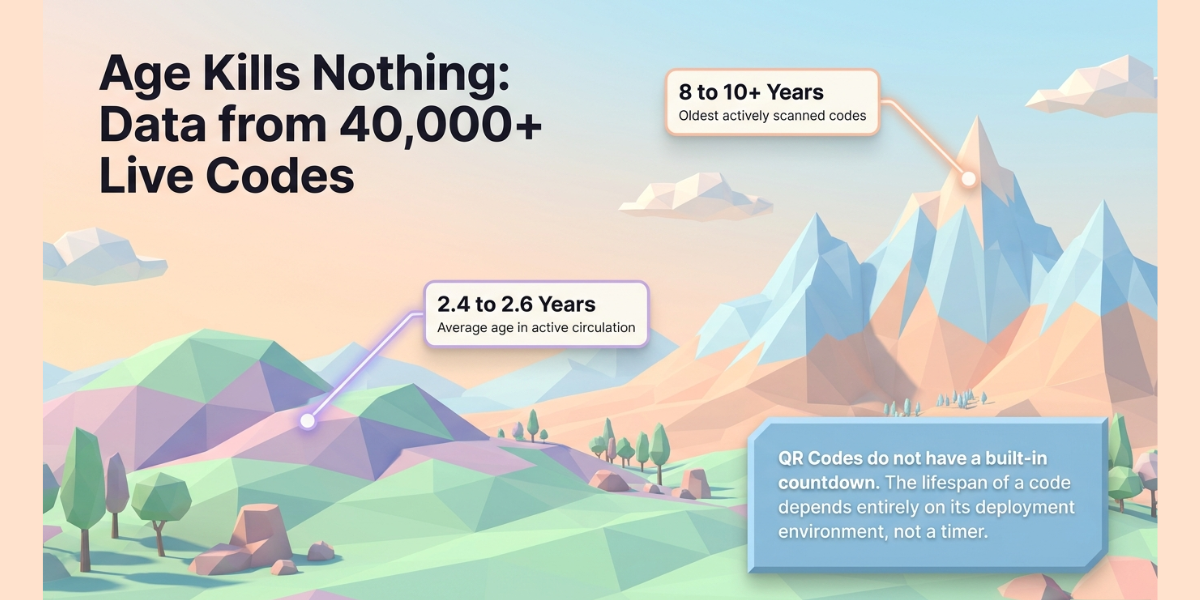
In Scanova’s 2026 platform data, the average QR Code in active circulation is 2.4 to 2.6 years old, and the oldest codes still being scanned are 8 to 10+ years old. Age, by itself, kills nothing.
Those numbers come from scan activity across the 40,000+ live codes on our platform, deployed in CPG, manufacturing, hotels, and F&B. Three findings stand out.
|
Finding |
2026 figure |
|
Average age of a QR Code in active circulation |
2.4–2.6 years |
|
Oldest codes still being actively scanned |
8–10+ years |
|
Average scans per CPG code older than 5 years |
13,000+ |
The typical active code is about two and a half years old. That average spans everything from six-week campaign codes to permanent equipment labels. It puts to rest the idea that QR Codes are short-lived campaign assets.
A decade of service is not theoretical. The oldest actively scanned codes in the dataset were created in the mid-2010s. They still resolve, and they still record scans, because their owners kept the account active and the destination live.
Age does not degrade performance. CPG codes older than five years average 13,000+ scans each and continue to accumulate.
A code created in 2018 with an active subscription and a working destination is exactly as functional as one created this morning.
Conditions around older codes have even improved, since every modern phone camera now scans QR Codes natively.
“We expected scan activity to fade as codes aged. It doesn’t. Codes die from neglect and redesign, never from the calendar.” – Scanova’s Research Team
The full age and scan-frequency breakdown by industry is in the Annual QR Code Performance Report. That leaves the question the averages raise: if codes do not die of old age, why do some stop working?
C. When do QR Codes expire? The four real failure modes
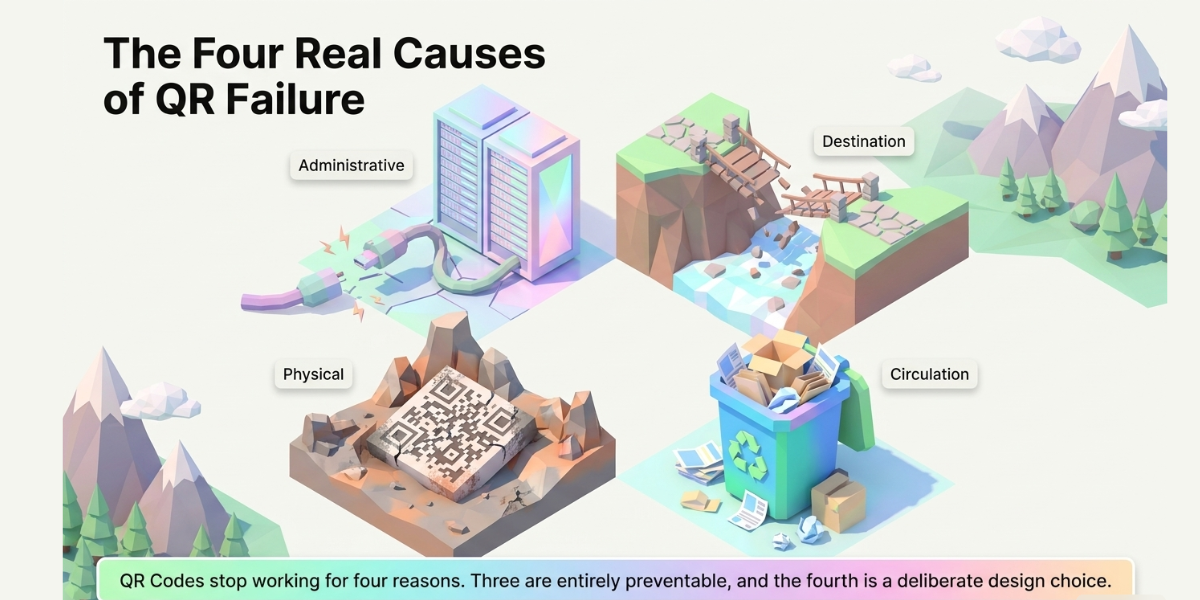
QR Codes stop working for four reasons, and none of them is a timer:
- The subscription behind a dynamic code lapses
- The destination URL breaks
- The printed code is physically damaged
- The medium it is printed on leaves circulation
Understanding these four turns “will my QR Code still work next year?” from a worry into a checklist.
1. The subscription lapses
This is the failure people usually mean by “expired,” and it is administrative rather than technical. The moment the account closes, the redirect stops resolving and every printed copy fails simultaneously.
It is rarely a deliberate cancellation. A company card expires. The account was registered to an employee who left. A subscription gets cut in a budget review with nobody mapping which live codes depend on it.
The fix is organizational: treat the QR platform account like a domain registration or an SSL certificate. It is infrastructure. Give it an owner, put it on annual billing, and add it to offboarding checklists.
2. The destination URL breaks
The second failure is ordinary link rot. The code scans perfectly and delivers the user to a page that no longer exists. Website migrations, retired campaign microsites, and CMS restructures are the usual causes.
For a static code, a broken destination is terminal. The URL is baked into the print, so the only remedy is reprinting everything.
For a dynamic code, the same event is a two-minute dashboard fix: point the code at the new page and every printed copy is repaired at once, including copies you could never physically reach.
Broken destinations are also quiet failures. The scan succeeds, so nothing looks wrong at the point of print.
Only the 404 and a dip in conversions give it away, which is why long-lived deployments pair QR Codes with routine link checks.
3. The printed code is damaged
QR Codes tolerate damage better than most people expect. According to Denso Wave, the company that invented the QR Code in 1994, built-in error correction lets a code lose up to 30% of its pattern and still scan at the highest correction level.
Tolerance is not immortality. UV exposure fades ink, abrasion wears laminates, and moisture warps labels. Physical failure is also gradual: before a damaged code dies, users experience slow or failed scans, which suppresses usage well before the code becomes unreadable.
Codes headed for harsh environments should be printed larger than the minimum, at high contrast, at error correction level H, on materials rated for the setting.
4. The medium leaves circulation
The fourth cause involves no malfunction at all. The packaging gets redesigned. The menu gets reprinted. The poster comes down. The code exits circulation with the material it is printed on, in working order to the last scan.
This explains the gap in our data between the average active code (about two and a half years) and the oldest (past ten). The ceiling on a QR Code’s life is rarely technical. It is how long the medium stays in service.
Codes on long-circulation media, such as product packaging, equipment labels, and manuals, serve for years. Codes on short-cycle media, like event signage and seasonal promotions, retire in weeks, exactly as intended.
The practical implication: a QR Code’s lifespan is largely decided the day you choose where to put it.
D. What does five-year-old CPG packaging reveal about QR longevity?
CPG codes older than five years still average more than 13,000 scans each in Scanova’s 2026 data, and they remain in active use. If you want to know how QR Codes hold up over the long run, packaged goods are the most demanding test available.
CPG codes are printed in enormous volumes on packaging that moves through warehouses, distribution, and retail shelves, then sits in pantries and bathroom cabinets for months or years. Reprinting is slow and expensive.
Whatever is printed must keep working, unattended, for the full life of the package run. A code printed on a label in 2021 is still routing shoppers to product content in 2026.
Two lessons follow from that number.
First, packaging QR Codes behave like durable channels rather than campaign assets. A campaign has a flight window; a package circulates for as long as inventory exists somewhere in the world.
The brands seeing this sustained scan volume treat the printed code as a permanent fixture and treat the destination behind it as the living part.
The same code has carried launch tutorials in year one, a promotion in year two, and updated regulatory information in year four. The print cost was paid once; every content change since has been free, because the update happens at the destination.
Second, longevity is a liability when nobody plans for it. The same five-year lifespan that compounds returns for a well-managed code multiplies the damage of a lapsed subscription.
Cancel the account in year three and you orphan every code on every package still moving through the supply chain, with no way to recall them.
CPG teams should assume their QR Codes will outlive the campaign, the agency contract, and often the tenure of the person who created them, and assign ownership accordingly.
The pattern repeats across manufacturing, hotels, and F&B, with different cycle lengths: scan performance follows the medium and the maintenance, not the calendar. And the audience keeps growing: our 2026 QR Code statistics report found that 44.6% of internet users now scan a QR Code at least once a month.
E. How do you make a QR Code that doesn’t expire?
If you want to know how to make a QR Code that doesn’t expire, the answer has five parts, and none of them involves the code itself.
- Match the code type to the job. If the encoded data will never change, such as Wi-Fi credentials or a serial number, use a static code. It is permanent by nature and depends on no one. If the code points to a URL, use a dynamic code, because URLs are the least permanent part of the system and you will want to update the destination without reprinting. For a detailed comparison, see our static vs. dynamic QR Code guide.
- Put the account on infrastructure footing. Register your QR platform account to a company identity rather than an individual, set billing to annual, name an owner, and document which live deployments depend on it. Nearly every subscription failure we see would have been prevented by this step alone.
- Keep destinations stable and owned. Point codes at pages on domains you control, and fold QR destinations into whatever link-checking routine your website already has. Audit static codes on a schedule, because they give no other warning.
- Print for the environment. Size the code for its scanning distance (rule of thumb: distance divided by ten), preserve the quiet zone, keep contrast high, and choose a higher error correction level for surfaces that will see wear.
- Watch the scan data. Scan analytics double as uptime monitoring. A code whose scans drop to zero overnight has almost certainly hit one of the four failures above; the sooner it is caught, the smaller the loss.
Follow those five, and the realistic answer to “how long will my QR Code last?” becomes: as long as the medium it is printed on stays in circulation. In our data, that can mean ten years and counting.
F. So, do QR Codes expire? The bottom line
No. Nothing in the format expires. Static codes are permanent, and dynamic codes last as long as the account behind them.
The field data tells a more useful story: across 40,000+ live codes, the average active code is 2.4 to 2.6 years old, the oldest have passed the ten-year mark, and five-year-old CPG codes are still averaging 13,000+ scans each.
QR Codes stop working for four reasons: lapsed subscriptions, broken destinations, physical damage, and media leaving circulation. All four are visible in advance. Three are entirely within your control, and the fourth is a design choice.
Which means “will my QR Code work next year?” was never a question about QR Codes. It is a question about your operations, and the data says the codes will hold up their end for a decade or more.
For the complete findings, with scan-frequency benchmarks, code-age distributions, and top use cases across CPG, manufacturing, hotels, and F&B, read Scanova’s Annual QR Code Performance Report.
G. FAQs: Do QR Codes Expire
1. What happens if a QR Code is not scanned for a long time?
Nothing. Scan activity has no effect on whether a code keeps working. A static code that sits unscanned for five years will decode the moment someone points a camera at it, and a dynamic code behaves the same way as long as its subscription is active.
2. Can an expired QR Code be reactivated?
Usually, yes. If a dynamic code stopped working because a subscription lapsed, renewing the account typically restores the redirect, and every printed copy starts working again. If a static code leads to a dead page, the page must be restored at its original URL, because the code itself cannot be edited.
3. How many scans can a QR Code handle?
There is no limit. A QR Code is not consumed by scanning; one code can serve millions of scans. In Scanova’s 2026 dataset, CPG codes older than five years average 13,000+ scans each with no decline in function.
4. Are QR Codes permanent on printed materials like packaging or business cards?
The code is permanent; the material is not. A printed QR Code keeps working for as long as it stays scannable and its destination stays live.
In practice, its working life ends when the packaging, card, or sign leaves circulation: weeks for event signage, 10+ years for packaging and labels in our data.